Monday, November 17, 2008

Kitchen Remodeling

Linda has been asking me (I won't say nagging) to get these pictures of the remodeling up. Here are the pictures and some words Linda wrote about the project:

Hi, everyone. You suffered with me during the remodeling. Here are photos of the finished project (well, not quite finished, we're still waiting for a shelf, but I am not going to ask again unless I get another bill. Billing stopped a month ago, so I figure I'm somewhat ahead right now on all of this).

John's posting before and after pictues. We did wind up losing my lovely built-in spice cabinet, a project I did myself this summer, but I was willing to lose it to get the rest of the job completed.

Wood floors, granite countertop, built-in microwave, under-the-counter sink, gas range -- we're hoping this will all come back to us when we sell the house. In any case, this is part one of the project. John will do a blog with photos of the remodeled bathrooms after we get this first blog on the kitchen up.

Here are the before pictures:


Posted by Picasa


And these are the after pictures:


Posted by Picasa


Posted by Picasa


Posted by Picasa

Saturday, November 01, 2008

Joe Biden Rally

I haven't been as active this election year as in the past. Probably it's because of the remodeling we've been doing and the fact that Linda recently retired and we've been travelling a lot. It's been hard to find time to canvas and answer phones and walk around trying to get the vote out.

But I did do one significant thing this time around that may -- in fact -- guarantee the election of Barack Obama.

I went to a political rally at the community market in Danville, Virginia.

Here's a picture a police officer at the rally took for my neighbor Kelly Brande:


Now, I got to explain what I meant when I said that my being at this rally may guarantee the election for my fellow Chicagoan, Barack Obama.

In my life I have seen three Democratic politicians who were running for president. I attended rallies for John F. Kennedy, Lyndon B. Johnson, and Bill Clinton. Each one of them became president. I never saw Mondale or Dukakis or Kerry, and -- not surprisingly -- none of those fellows became president.

How can I explain this? Well, really I can't -- it's like so many of the great truths, a mystery from top to bottom, port to starboard.

Truth be told, I did see one Democrat who didn't become president. That was Al Gore, but his not getting to be president doesn't really deny the power of my gift. He did win the election but was robbed.

I hope that doesn't happen again

Wednesday, October 22, 2008

Graham Lewis--Forever Came Today

I heard last night that Graham died early yesterday.

I had known Graham for almost 20 years. He was a student of mine at Eastern Illinois University a long time ago. It was a course in Literature and Psychology, and Graham was a student I liked to see in class. He was smart, really smart, and he said things I liked hearing about Freud and Dostoevsky, Jung and Eugene O'Neill. He would spin that Psych theory like a top. Sometimes his life as a student would get in the way of his studies. He was running with Joe Butler for student body president and vice-president, and they were running a pretty wild and unconventional campaign.

Sometimes, Graham would come to class unprepared during the race, but he was always upfront about that. He'd come in and say, "Doc, I'm not going to do you any good today." Then, he would smile and shrug, and you knew that he would get it all together tomorrow or the next day.

Years later, I met him again. He got a job teaching in my department, and he taught there for the rest of his life.

We were both smokers when he first started teaching, and we would meet outside Coleman Hall in all kinds of weather to smoke a cigarette between classes. He was a good person to share a cigarette with. He was always upbeat, always smiling like he did in class long ago when he was a student. You would join him outside with some kind of crazy or sad story about a student's meltdown or failure, and he would smile and shrug, say something reassuring about the student. He was a good person to talk to.

Graham was also a good poet, and I want to post one of his poems here from his book Forever Came Today. The sonnet is from a sequence about a Coles County, Illinois, woman named Marjorie.

Marjorie Walks On Water

She sits talking to the crickets and rain,
the glow of town melting
to the flat black mud of Coles County.
This morning she heard music from the sky,
rolls of thunder teasing her into the fields.
She followed across gulleys and creeks,
each rumble a revelation just out of reach.
Hours later she found herself wet and alone.
When the moon came her breasts ached,
her monthly blood bitter and warm.
She sits rocking, rocking in the darkness,
telling it that always magical story
of how all she ever wanted
was to heal the sick and raise the dead.


You can see more of Graham's poems at the EIU online journal Agora.

__

Postscript:

Memories of Graham

I received the following note from Jean Toothman, the secretary of the English Dept. at EIU:

Friends,

I've had several requests to add messages of condolence or memories of Graham Lewis to the brief biography we have for him on the web site. While I lack the programming skills to make that an interactive page, it would be quite simple for us to add your memories or messages to the page.

If you'd like to add a memory or message of condolence to the page, please email it to Ginny (vldibianco@eiu.edu).

Thursday, October 02, 2008

Linda and the Contractors

As some of you know, we've been having a professional contractor do some work in our new house in Danville. He's been working on the kitchen and the bathrooms and on the floors upstairs. I've been pretty much trying to stay out of the way. I'm spending a lot of time in our beautiful basement which Linda remodeled and made a fit place to sit and write in. Like Toni Morrison suggests in her novel Sula, "Sometimes, when things are going crazy, all you can do is to just get out of the way."


Linda, however, is in the thick of the work, tracking what's going on with it, and recently, she wrote up a piece about it. Here's her story:

Lillian told me that she read an essay by a woman that compared working with a contractor to having an affair. I know just how she felt, well, sort of anyway. Friday our contractor, Jimmy, was here sweet talking me with promises. We’d sleep in our own bed come Monday. We’d have a toilet and sink right there, finished, to clean up in at any hour of the day or night. The floor would look fabulous, the room would be set back. It would be like a night at the Ritz. Yesterday I started to worry. I got long suffering John to help me put our clothes back in their closets so that Monday morning Jimmy’s crew would be moving furniture only. So we worked and worked and worried some more, but we slept deep in anticipation of this morning’s busy chaos.

This morning came with one worker, a big kid I’d never seen before, and when I asked what he would do first, he answered but I couldn’t figure out what he’d said. Half hour later a short skinny guy who looks a bit like a heroin addict came by, friendly as could be, to do a bit more looking. And right on his heels we get the sanders, here to start their work day.
.
So I called the contractor’s office to complain that my husband was moving furniture (I am certain they aren’t going to pay John), and where is the crew Jimmy promised me. Many calming words and sweet promises. And then I get a plumber show up at the door. He’s trying to put in a toilet and sink, running up and down the stairs to the basement leaving all the doors open, the cat running every which way, and he’s in one lousy mood since the bathroom is full with furniture, books, clothes, boxes. I ask him if he’s ever had a worse environment, and he says “not lately.” I joke (big mistake) that even is he gets the sink and toilet finished, we won’t be able to get to them and we don’t have a bed up in the bedroom in any case. He grunts, says something I can’t understand, and runs back down the stairs.

John calls me from the front door to say Jimmy’s send someone to check to see if the bedroom is set up for us. I say we took the futon mattress to my study so that we’d salvage somewhere to sleep, but the bathroom is going to be inaccessible since the floors will be wet with polyurethane in any case. He mumbles something about camping, I go upstairs to close the door to the bedroom.
.
After I come down to gripe at John about it all (he’s holed up in the family room reading emails about his blog), I decide to check the bathroom again.

When I get upstairs I discover everyone is gone, except for the guy with the sanding machine that sounds like a jet engine is revving up in our living room. I run to the front door and discover all the cars and trucks are gone. Here I am waiting. Still no Jimmy. But I do have the check I wrote for his second draw on the work sitting on my desk, and I’ll be damned if I give it to anyone but him, if he ever shows up that is.

Wednesday, September 17, 2008

The Deaths of Writers


I've been a reader for 50 years and I've seen writers I love die, some naturally and some unnaturally. I've said goodbye to Faulkner, Hemingway, Plath, Steinbeck, Kerouac, Primo Levi, Isaac Bashevis Singer, and Saul Bellow.

The deaths have always hit me hard because the relationship you have with a writer is different from the relationship you have with anyone else. In the secret place you go to when you are reading, you and the writer share dreams and fears and wishes and hopes in a way that is nothing like your relationship with anyone else.

The writer is your lover and your confessor, your mother and your father, your God and your Satan. And you are the same for him. The writer tells you what he dreams and what he fears. When he tells you what he dreams, you help him come a little closer to those dreams. When he tells you what he fears, you help him push those fears away a little bit. And this works the same for you when you tell the writer in this secret place about your fears and dreams.

It's hard when a writer you love dies, but it's only hard for a while. His death begins to fade when you pick up his book again, return to that secret place.

Sunday, September 14, 2008

re: David Foster Wallace and Suicide

I read early this morning that writer David Foster Wallace, the author of Infinite Jest, committed suicide a couple of days ago. His wife came home Friday night to find that he had hanged himself.

I didn't much like his fiction. Its irony and postmodernism seemed familiar, but his essays were sharp and funny, and he was from central Illinois and I spent much of my working life teaching lit and creative writing there, and I feel a kinship with young writers from there.

I'll miss the guy.

What amazes me about him is that he apparently had everything, talent to burn, time to write, a sweet teaching load, people reading and loving his books, and he kills himself.

Like I said, I don't get it, but my wife tells me I'm naive, that people who kill themselves have reasons that the folks left behind don't understand. It's not about what they have, but rather about what they feel they don't have, and you and me will never know what that loss feels like.

I'm sure she's right.

A couple of years ago, Marty Scott, a friend of mine, a terrific writer and a kind, compassionate, generous guy killed himself. I couldn't make sense of that death either, but one thing that helped me was a song by Lucinda Williams that I found right after my friend killed himself.

Here it is:

Sweet Old World

See what you lost when you left this world, this sweet old world
The breath from your own lips, the touch of fingertips
A sweet and tender kiss
The sound of a midnight train, wearing someone's ring
Someone calling your name
Somebody so warm cradled in your arm
Didn't you think you were worth anything

See what you lost when you left this world, this sweet old world

Millions of us in love, promises made good
Your own flesh and blood
Looking for some truth, dancing with no shoes
The beat, the rhythm, the blues
The pounding of your heart's drum together with another one
Didn't you think anyone loved you

See what you lost when you left this world, this sweet old world

(There's a version of this song on youtube sung by Emmylou Harris.)

Thursday, September 04, 2008

The Presidential Lottery


Garrison Keillor wrote an article for the online journal Salon called "Who wants to see Sarah Palin as the next president?"

I read the article and started thinking about how crazy elections and primaries and conventions are. We go through all of that anguish and trauma and anger for months upon months and we end up with presidents like: George W. Bush, Bill Clinton, George (the other) Bush, Ronald Reagan, Jimmy C, Richard Nixon and on and on and on.

Really, it's a crazy system we have, and I wrote a letter to Salon offering something a little different.

Here's what I sent to Salon:

The Lottery

Watching the Bush administration treat Iraq like its private AMT for the last seven years, and now faced with the possibility of watching McCain and Palin "bring the pain," I'm starting to think that there needs to be a better way of selecting a president.

Maybe it's time for a national Presidential lottery, a random picking of a president based on only two criteria: you can't be a felon and you got to be at least 35. With our technology, we could easily put everyone who meets the criteria in a big electronic fish bowl and draw a winner.

I know some people will say we already have a lottery. They look at Sarah Palin and say, "She's kind of random. There doesn't seem to be much reasoning behind her selection."

But I think those people miss the point. Palin wasn't picked randomly. McCain must have thought it out, or least thought about it.

Really, we need to get beyond all of this and work on putting in a national lottery.

The biggest advantage is that the odds are we wouldn't get some politico pit-bull, raring to chew off the leg of any Democrat that gets in her way, and we wouldn't get some fuzzy-headed geezer like McCain who unleashed her.

Instead, we'd get some average, random American (like me) who, I'm sure, would do as good a job as McCain or Palin as president without all of the hateful posturing and silly name calling.

Saturday, August 09, 2008

HAVE YOU EVER MET A RICH PERSON?


A couple of days ago, my friend poet Christina Pacosz sent me an article entitled “Rich Begin Feeling the Pain in Down Economy.” It was written by Mark Jewell for the AP, and he got me thinking about rich people.

What always amazes me about rich people is how little contact they have with the rest of us.

I'm 60 years old, have lived in America most of my life, have been educated here in private and public schools, have a PhD from a major university, have taught in American universities for 35 years--and still I have never met a rich person, I mean a really rich person, somebody with a yacht or a jet and a personal assistant to manage his lunch dates.

Where do the rich keep themselves?

I've met unemployed people, farmers, doctors, artists, factory workers, peddlers, homeless folks, business people, writers, lower and middle class people by the thousands, but I have never met a rich person.

Where are they?

Do they live on special islands off the coast of America?

I sometimes suspect that may be true. One time I went to St. Mary's Island off the coast of Georgia for a vacation with Linda and some friends from Valdosta, and that island was connected to another island by a bridge. However, you couldn't get across that bridge unless you were one of the rich folks living on that island.

How do I know this?

There were armed guards (security professionals) stationed at the foot of the bridge. I asked one of them before he told me I couldn't go any farther.

Am I the only one who has never met a rich person?

I don't think so.

When I used to teach F. Scott Fitzgerald's THE GREAT GATSBY, the discussion in my class would sometimes turn to Fitzgerald's statement that the "rich are different from you and me," and I would ask my students at Eastern Illinois University if they had ever met a rich person. These students were pretty much a cross section of the population of Illinois with students from all over the state. So I always figured I would run into a student who had met a rich person. But that never happened.

Once in a while I would come across a student who had met someone who had met someone who had met a rich person, but pretty much most of the students hadn't met a rich person or met anybody who had.

So I guess Fitzgerald was right. The rich are different from you and me.

They are invisible.

--

Sunday, June 22, 2008

60th BIRTHDAY POST

Today is my birthday. June 22nd. I'm 60.


A lot has happened in the last year. I published two books of poetry (Lightning and Ashes and Third Winter of War: Buchenwald), got nominated for a Pulitzer Prize for the latter, finished a novel that an agent was really interested in and then lost interest in, celebrated my wife Linda's retirement, moved to Danville, Virginia to be closer to our daughter Lillian, and got shingles.

All of those happenings were on the plus side--except for the shingles.

Really, shingles have made this birthday special.

Before the shingles, I always felt pretty good. Beside doing a lot of writing and reading and all the things I mentioned above, I was getting lots of exercise. Two or three times a day, I would run or ride my bike or lift weights or nordic track or do yoga. Like I said, I was feeling pretty good.

Then I got shingles right after the move to Danville. At first there was burning and stabbing pain, what one doctor called "lightning pain." It hit about 5-6 times an hour. Now there's just burning pain--pretty much all the time. I was taking about 3 kinds of pain killers and using lidocaine pain patches. All of that medication zonked me out--made me sleepy, dizzy, nervous, short-tempered, confused, and it didn't do much to get rid of the pain. Doing all those meds made it impossible to do much of anything. So now, I try to take no more than one pain pill or patch every day.

But slowly, it's all getting better. Very slowly.

I've started writing again, and I've started reading again, and I've started exercising again.

I figure pretty soon I'll be 59 again.

(If you want to read my 59th birthday post, just click here.)

Monday, May 12, 2008

MOVED

We are finally moved. Sort of.

Two Saturdays ago, we loaded up all the furniture and boxes that we had been packing for the last two months. Two Sundays ago, we drove the 570 miles from Valdosta, GA, to Danville, VA, in a caravan of two 26-foot long U-Haul trucks and three cars. If you're wondering how Linda and I were able to do all that caravanning, we had help. Our friends Ari Santas and his son Michael and Michael's friend John Reed helped us load and drive. They also-- along with our daughter Lillian -- helped us unload. We pulled into Danville about 7 pm Sunday night, and we immediately started unloading. By 230 am, we were done.

Except for the unpacking.

Ari, Michael, and John had to get back to Valdosta, so they got into Ari's little red car and drove.

Then we started unpacking.

It was all going smoothly until I came down with shingles. It's an illness with a funny name. I mean, I used to snicker when people said that they had shingles. No more. The pain around my heart and lungs was so strong that I thought I was having a heart attack.

The doctor gave me a shot of some kind of anti-shingles drug and a shot of B-12 and three prescriptions for a pain killer, an anti-inflammatory, and an anti-shingles drug. The drugs are knocking me out, making me dizzy, sleepy, and dopey. I’ve also been running a temperature and getting the chills.

Linda at one point took some photos of the two wide, red bands of rashes across my back, and we were going to post them on this blog, but we both decided that the world doesn't need to see how bad these rashes are.

Anyway, Linda and Lillian are unpacking while I sort of sit around and nap and try to keep from shaking with the chills.

Thursday, April 24, 2008

TAGGED


I've been tagged by my friend Sara who has a blog called AND THE COW SAID MOO.
.
I'm not sure what tagging means but she sent me some rules:
.
1. Pick up the nearest book.

2. Open to page 123.

3. Find the fifth sentence.

4. Post the next three sentences.

5. Tag five people, and acknowledge who tagged you.

Here goes:

This is from Kolyma Tales by Varlam Shalamov. He spent 17 years at hard labor in Siberia. This is a book he wrote about that.

"You've been exposed, Merzlakov," the neuropathologist said. "But I put in a good word fror you to the head of the hospital. You won't be retried or sent to a penal mine. You'll just have to check out of the hospital and return to your previous mine--to your old job."

I'm supposed to tag people now, 5 of them. I'm going to tag 5 people who have absolutely no time for this: Marty Williams, Tania Rochelle, Jeff Newberry, Joe Glaser, Linda Calendrillo.
.
Nothing's easy. That's the moral of Shalamov's book and Dostoevsky's Crime and Punishment and Tadeusz Borowski's This Way for the Gas, Ladies and Gentlemen.
.
Life tests us and we always fail, and the penalty is always the same.
.
Don't ask.

Monday, March 17, 2008

12 Fotos of Mustaches

My friend Jamie Harmon is an artist and photographer who occasionally sends me postcards he makes himself based on photographs he's taken. The cards have haiku like poems on the back side too. Both the photos and the poems are first rate and always inspiring.
.
I got the most recent card this last Saturday. The card came just as we were visiting with Linda's parents Tony and Mabel, her sister Laura and her husband Bill, and their son Christopher and his wife Christine and their infant daughter Nicole.
I asked them each to play with the postcard, and then I took some pictures.


PS. Jamie Harmon's got a great web page where you can see a bunch of his photos and a lot of other things: http://uberphoto.com/


By the way, here's a picture of Jamie and me. I'm the guy smiling.

Saturday, March 01, 2008

Solitude

Solitude?

Someone should write a history of it.

Think about it. Probably for the first million plus years we were here on earth, we were up to our ears in solitude. We'd watched the sky and the horizon for a bit of smoke, listen for the turning of a clumsy wheel or a whistle coming from some tall grass. Anything that might signal that our solitude was about to end.


At night, we'd sit in a tree or a cave and practice our smiles and handshakes on the off chance we'd meet somebody the next day coming toward us through that grass. We'd also practice our “company’s coming” talk, "Hi, I'm Abel from this tree here, glad to meet you. You just passing through? Like to stop?"

Sometimes you see a bird all alone on a tree, turning his head this way and that, pausing and listening the way birds listen to the sounds in the wind when they're all alone. We were probably like that bird most of the time we were on earth--maybe up to about 15,000 years ago when we learned to hunker down together.

It was probably a good break from the solitude and what was behind it and always coming closer, the loneliness.

A person gets tired of sleeping with his back exposed to the wind and the weather. He wants to have someone behind him keeping his back warm. It was probably that way when he was a baby, his momma pressing his back into her warm belly. You miss that kind of loving and go searching for something that will break the loneliness and the fancy Sunday-dress version of loneliness, solitude.


But then something happens, and we start getting a little too much of that pressing.

Maybe it's the growth of cities or the rise of the merchant class or the start of the industrial revolution with its ugly factories, and all we got then is people pressing into us, some pressing in a loving way but more just pressing, just pressing a little more each day until we start thinking down into our DNA and remembering the solitude we had so much of so long ago, and we start missing it.


(Photos: The first photo of a field in Illinois is by the poet and photographer Michael Healey. The photo of Walden Pond 2007 and the Bellagio Casino/Las Vegas 2007 are by me.)

Thursday, February 14, 2008

AWP 2008 Update!

After I wrote my previous blog about the AWP, I started hearing from people I saw or didn’t see at the conference, and I started remembering stuff I wished I had put in the previous blog, but early on I promised myself I would never revise blogs. Period means period.

So I’m getting around that promise by doing another blog.

First, I wanted to mention the people that I saw that I didn’t mention earlier.

My first AWP blog made it sound like I was pretty lonely there (and I was), but that probably had as much to do with my own general gloominess as it did the conference. Beside all the people I did mention in the previous blog, I saw two others I wanted to get in.


I ran into David Radavich, one of my EIU friends, about five times at the AWP Bookfair. He was usually going one way and I was going another. We nodded and shook hands and said this and that, but I guess I was too discombobulated to say to David, “I’m lost, let’s have coffee.”

I also ran into Thad Rutkowski who I recently read with in DC. We did have coffee (Starbucks) and talked about how confusing the conference was. He gave me a copy of his book Tetched: A Novel in Fractals.

(If you are reading this and saw me or talked to me at AWP, please drop me a line at jzguzlowski [at] gmail.com, and I will be sure to post your name in my next AWP update.)


Then there are all the friends who I didn’t see but who I found out later were there: Jean Braithwaite, Irene Willis, Sheryl St. Germain, and Jeff Vasseur.

I ran into Jeff at La Guardia Airport when I was heading back to Valdosta. I said, “I didn’t know you were at the AWP,” and he said, “I didn’t know you were at the AWP.” We grinned and shrugged, and talked about the general confusion at the conference; and then he said something that really stuck with me. He said (and I’m paraphrasing here), “Being at the AWP is like being on Mars.”

I’ve thought about that a lot and figure that that gets to the heart of it as well as anything. It’s like we’re astronauts in separate little personal rockets aimed at Mars, and NASA hurls our souls – as Bruce Springsteen would sing it – into that “great void” beyond, and some how most of us make it, and then we start wandering around Mars looking for other little personal rockets with poets and writers inside.

We find some of those other astronauts but others we don’t. It’s a big dusty planet, and we have other things on our mind.

And of course some of us don’t make it to Mars.

Friday, February 08, 2008

AWP: Associated Writing Programs Conference 2008

I went to the AWP Conference last week.

I wasn’t going to go at first because I don’t much like conferences. But I started ticking off the reasons I should go: I had published two books of poems in 2007, and I had the chance to do book signings for both, and I was looking for an agent for the novel I’m working on and somebody told me that agents at the AWP were as thick and friendly as kittens. So I paid my $200 membership/registration and booked my $300 airplane ticket, and packed up my books and set off.

The conference turned out in a lot of ways not to be the conference I had imagined it would be.

I was all fired up about seeing and hearing some of my favorite writers, but circumstances way-laid me or way-laid them:

A. S. Byatt got really sick so she didn't read. Louise Gluck broke her wrist so she didn't read. E. L. Doctorow didn't show up so he didn't read. Martin Amis and John Irving were on at 830 pm on different evenings. They did read but I was in bed by then and didn’t hear them read. Frank McCourt and Billy Collins and Cynthia Ozick were all reading at the same time while I was watching John Surowiecki’s great one-act play “My Nose and Me” (A TragedyLite or TradiDelight in 33 Scenes) about a nose that gets skin cancer.
.
Then there were all the events that I screwed up because I got the times wrong:
Stuart Dybek's talk about Richard Yates, Carolyn Forche's reading from her new book, Joyce Carol Oates' reading from whatever she read from, Marian K. Shapiro's book signing, the Blood to Remember: American Poets on the Holocaust reading, a panel on how writers use memory.

And that list goes on and on.

Then there were all the events I went to that I wished I hadn't:

--one well-known poet reading his flat poems about Asia

--an older poet who didn’t seem to know much about grief and faith reading poems about grief and faith

--another older poet reading poems about national security and the homeland etc that wanted to be ironic and satirical but weren't.

But mostly what I did was wander around the three floors of book stalls trying to find the next session.


When I wasn't doing that, I was sitting at either the Steel Toe Books table or the Finishing Line table. I spent a lot of time at those tables, and really that time was one of the highlights of the conference. There were 8000 writers at the conference, and amid all that talk and scurrying a guy can get worn down shorter than a pencil nub unless he can find some place to sit and take life and writers as they come--one by one.

I did that at the Steel Toe table and the Finishing Line table.

I met some nice people at both of them and had good conversations about books and writing: I talked to Leah Maines, Katie Hae Ryun Leo, Dale Sprowl, Elizabeth Bradford, Bill Zavatsky, Robert Cooperman, J. C. Todd, Amy Groshek, Sean Conrey, Jason Lee Brown, Mary Biddinger, Lisa Siedlarz, Karen Zabarowski Duffy, and the essential Tom C. Hunley -- and I sold and signed some books too!

And there were some other moments that I wouldn’t have missed:

Really, I would go again just for the goof of going up an escalator and watching Billy Collins decide between buying some book that I can't identify from 20 feet away and some other book I can't identify no matter how hard I try.

Or how about when I went up to some famous poet and told him I was a friend of a friend, and he thought I was the guy who was supposed to take him to his next session. He started following me and then when he realized that I didn't know where he was supposed to go, he had to figure out where he had been. It wasn’t easy.

Or how about when I saw Joyce Carol Oates being smuggled out of the Hilton Hotel in what seemed like a disguise. It was a floor-length red/maroon plaid cloth coat (what used to be called a maxi) and a matching floppy hat. It was the same shape as the one Ingrid Bergman wore in Casablanca, but a totally different color/pattern. Wilder by half!

Or how about running into one of my favorite people, the poet Charles Fishman, and having a funny conversation with him about pretzels.

Or how about when I had that enormous bowl of Chinese vegetable and noodles soup with my Valdosta friend Marty Williams.


Or how when I saw two old friends I hadn’t seen in too long: Lola Haskins and Gray Jacobik.

That was the best part.

Sunday, January 20, 2008

My Mother's Optimism

My Mom had two bouts of cancer in her last years.
.
First, she had breast cancer and a couple of years later she had ovarian cancer. For about five years, it seemed like all of her life was surgery, radiation, and chemo-therapy.
.
While she was recovering from the second cancer, I wrote a poem about her experience, and it appears in my book about my parents, Lighning and Ashes.
.
Recently, the poem was republished by The Survivor's Review, an online journal for and about cancer survivors.

I thought you might like to see the poem and maybe take a look at some of the other poems and stories there.
.
Here's the link:
.


Thursday, December 27, 2007

Garrison Keillor's Writers Almanac: "What My Father Believed"

Garrison Keillor's reading of my poem "What My Father Believed" from my book Lightning and Ashes is now available at the Writers Almanac site:

http://writersalmanac.publicradio.org/programs/2007/12/24/#friday

This poem talks about my father's faith, how he learned about God in Poland as a child, and how his faith sustained him in the concentration camps in Nazi Germany.

Friday, December 21, 2007

Merry Christmas and Happy 2008 to All our Friends and Family!

I’m back writing the Christmas letter this year. Linda filled in for me last year, and she received a lot of excellent reviews, and in the past three or four weeks, she’s received letters asking her to continue doing the Guzillo Christmas letter. A lot of these letters came following her recent blog about pecan picking in Georgia. But we made a deal last year, so I’m back doing it this year.
.


I want to mention first that Linda’s Uncle Charlie died in August. Some of you who’ve read my blogs about him know he had pancreatic cancer that grew increasingly bad over the summer. Linda and I drove down to Florida a number of times to be with him and help him as his condition got worse. He died quietly in his sleep on August 24th. We’ll miss him.

Linda’s big news is that she’s decided to retire as of July 1, 2008. She’s been envying how laidback I’ve been since I retired, and she finally turned in her letter. I’ve noticed already that she seems more laidback than before. In fact, our cat Samantha has been spending more time sleeping on her stomach than on mine. I may have to get my own cat if Linda gets any more laidback.


Linda’s plans for our retirement? We hope to do more traveling. We’ve started talking about a big, long, two or three week cruise through the Panama Canal and up the boot of Baja, California, and out across the Pacific, maybe to Hawaii or maybe further to Tahiti or Thailand or Taiwan. Or maybe we’ll just stay here in the states and do a Casino Crawl from Las Vegas to Henderson to Reno and Winnemucca, Nevada.

By the way, she wanted me to tell you all that the pecan picking this year has been superb. Bigger nuts and more of them! She thinks it may have something to do with the presidential primaries that are coming up.


Lillian continues to enjoy teaching in Danville. This is her fourth year at George Washington High, and she’s recently been tenured. Like her mom, Lillian is interested in going beyond the classroom. She’s been commuting to Lynchburg College two or three nights a week this year, where she’s been working on her Master’s in Educational Leadership. This coming May she’ll be getting that Master’s. By the way, this last summer, she served as principal at her high school! She expelled five students!

I’ve been focusing on my writing. I published Lightning and Ashes and Third Winter of War. The latter was nominated for the Pulitzer Prize in Poetry. Right now, I’m working on a novel about a German soldier in Russia during WWII. Joyce Carol Oates published the first chapter in her journal Ontario Review. I’m also blogging as fast as I can and doing presentations about my parents all over the place, and if you read this before December 28 you can hear Garrison Keillor reading my poem “What My Father Believed” on NPR’s Writer’s Almanac.


Love from us to you,

Linda and John
.
.
(the photos? First it's a plate of Christmas bulbs, then Linda and her brother Bruce, then Lillian, then my sister Donna and me in a refugee camp in Germany.)

Tuesday, November 27, 2007

Pecan Picking Time in Georgia--Guest Starring Linda Calendrillo!

My wife Linda showed me a letter that she was sending to her nephew Matt Calendrillo and his wife Katie, and I said, "Linda, this has to be a blog!" Linda was sceptical.

All she had done, she said, was write a letter to Matt and Katie thanking them for sending her some nuts that they picked near their home in Pennsylvania.
.
I said, "No. It's more than that. It's perfect blog material about something you love--Pecan Picking."
.
She looked at me and said, "Well, you're the one famous for blogging. Go ahead."


Here's the letter she wrote:


Dear Katie and Matt,

How can it be that it's taken me so long to thank you for your nuts?!? First, I had a problem finding your email addresses. Then, I lost your phone number, so that plan went belly up. But I finally found your email address.
.
So back to the nuts.
.
PA nuts are scrawny compared to GA nuts (GA squirrels are scrawny compared to PA squirrels, so all this makes no sense to me), but nuts are nuts and we did enjoy investigating the ones you sent and eating them. Are you still picking them up? Is the later crop bigger? Thinner shelled (boy, they were hard to crack)? Less oily?

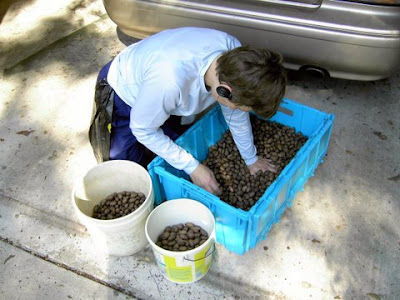
We are having a boom year here and have big vats of nuts all over our garage. I am hoping John will make the trip today to sell nuts and have other nuts cracked and blown. In GA, we have odd little seasonal businesses that set up to prep nuts for individuals. We pay around 50 cents a pound to have the nuts cracked and blown so that we can then easily separate the shells from the meat of the nut to freeze them.

You can imagine that we're talking volume here. I bet we'll have around 20 pounds cracked today. We had 12 pounds cracked a couple of weeks ago.

When we get the pecans after they've been cracked and blown, they come to us in two paper sacks. In one bag, there are mostly nuts. In the other bag, there are mostly shells. The job comes in when we need to separate the nuts from the shells. Separating the nuts from the shells is important work. If we're not careful, we get shells in the cookies and crunch down on shells when we eat a handful of nuts as a snack.


I'm giving you this background in the hopes that as kindred nut-picking spirits you'll be able to share the wild ways of the PA nut traditions.

We also have large businesses that buy nuts from us locals and sell them to Northerners (known here as yankees, with a derisive slur). These businesses pay us about 50 cents a pound, and I suspect we'll have well over a hundred pounds to sell today. Our biggest year was 400 pounds.

We may hit that this year again if John and I can keep our backs in working order. Bending down to pick up pecans is not for babies!

In fact, working with pecans is work!

Saturday, I spent three hours on the roof of our garage harvesting nuts, by the way. If you have a roof, with nut trees overhanging it, you might consider going up there to check out your crop.

So much for nuts.

I need to get back to work.

Love,

Aunt Linda

Friday, November 16, 2007

The Skies Over America by Matt Flumerfelt

I read a lot of poems and meet a lot of poets, and one poet whose voice always moves me and excites me is Matt Flumerfelt. He's a poet who will open your eyes and get you thinking and feeling.


THE SKIES OVER AMERICA


The skies over America

are vibrant as a Pollock painting

and dissonant as a Schoenberg

symphony. They’re the canvas

on which we scrawl the graffiti

of our lives.

.

Ours is a garden where

every flower may flourish,

bitter nightshade and evening

primrose, a Mendelian greenhouse

where hybrids are the rule

and whore lies down with priest.

.

We’re enamored of the camera.

If we could, we’d like to film

the destruction of the world,

even though no one would be left

to watch it explode a second time

except a few seagulls.

.

America was born to immigrant

parents in a sharecropper’s shack.

Three acres and a mule were its

only possessions. It was suckled

on hard work, cheap whiskey,

tobacco, cornbread and collard greens,

and the promise of eternal life.

.

The skies over America

are crumbling. They’re responding

well to therapy. They need

more antioxidants, plastic surgery,

yoga lessons. They’re weeping.

The skies over America are

closed for remodeling.


---------------------------------------------------------------------------------

Matt's poem "The Skies Over America" is from his new book The Art of Dreaming.

It's available for $10, plus $2 for shipping.

You can order The Art of Dreaming from him at

29 loganberryCircle

Valdosta Ga 31602
.
Or you can email Matt at mattflumerfelt@bellsouth.net

Thursday, November 01, 2007

Valdosta Halloween--2007

We had 4 kids stop by for tricks or treats, a pirate, a witch, a batman, and a kid who didn't know what he was dressed as.


The pirate kid was proud of his costume even though he didn't have a hat or wig. He left them in the car his mom was using to drive him from one house to another. He said, "It's just too hot for a wig. That's why I'm not wearing one!" We gave him a quarter.

This pirate boy stopped by at about 7 pm.

After that, it was quiet.

At about 730, I went outside and stood on the front porch for a while to see if there was anyone coming. There was no moon yet, and all the houses on both sides of the street were dark. A car drove past going west toward the Walmart near I-75.

I looked across the street at the house where these 3 young girls live. It's a big old Victorian just like ours. Every year we've been in Valdosta, the girls have made it over--even when the youngest was 1. She wore a white and gold princess costume that year, and had her big white cat with her. The cat didn't wear a costume.

This year they didn't make it.

Their house was dark.

Thursday, October 11, 2007

Simple Polish Soup

A couple of days ago I got a Recipe Chain e-Letter. Don't ask me to explain how it works. It was so complicated that I was going to just delete the thing, but when I told Marty Williams that's what I was going to do, he said, "Just write out a simple recipe and send it to Tania Rochelle and be done with it."

I like Tania. She's a good person and a good poet, so I said I would.

Here's the recipe I sent her:

Hi, Tania,

I'm no good at cooking, so I can't vouch for anything I say about recipes or food or putting stuff on the table. I commuted for 8 years, was away from my wife for 2-3-4 days at a time, made my own food and everyday I ate the same thing, a micro waved veggie burger and a can of Progresso minestrone soup.

Having said that, let me say that the following is a real recipe.

Here it goes:

When my mother was in her late 70s, she couldn't cook for herself any more. Her heart and her back had both given out, and she couldn't stand for more than a minute or two. When you can't stand, you can't cook.

She started having her meals brought in by a charitable organization in Sun City, Arizona, where she lived after my dad died. This food was pretty miserable: Salisbury Steaks, tuna salad sandwiches, little cups of salad, vanilla cup cakes--stuff like that, five days a week. They would bring a white bag of this everyday around noon, and it was expected to last her through lunch and dinner. On the weekends she was on her own. She would have a friend bring her some chicken from KFC or a piece of cooked ham from the deli section at the Safeway Supermarket down the street. She would microwave this food Saturday and Sunday. Monday, she would wait for the guy from Meals on Wheels to bring her another bag of ham salad or egg salad sandwiches.

It was like this for about four years.

She didn't complain much, except about the tuna salad. She had a gallbladder problem and the onions in the tuna salad were hard on her gall bladder. She would try to pick the tiny shards of onion out of the tuna salad, but this got harder and harder as her eye sight gave out. (When she finally died, it was after a gall bladder operation. She survived the operation, but she had a stroke afterward that shut down her whole body. But that's another story.)


Anyway, when I would come to visit, she was always happy to see me because she could always talk me into cooking for her. I hate to cook and I hated to work around my mother. My mother learned discipline from the Nazi guards in the concentration camps. She expected you to follow orders and she expected you to do it right. There was no screwing up allowed around her. If you did, she would freeze you out, turn her sarcasm against you. Call you a baby or a fool. Tell you that you're a college professor and still you can't boil a stinking egg!

Like I said, I hated to work with and around her, but I cooked for her. She knew I was a fool with my hands, that I couldn't make the things she really wanted to eat like pierogi or golumpky, but she also knew that she could maybe talk me through some simple dishes. Navy Bean Soup was the one she had me make most often.

We would start making the soup the night before by putting the beans in a pot full of a couple quarts of water. This would have to soak overnight. The first time she had me make it, I asked her why I just couldn’t follow the directions on the package, and let the beans soak under boiling water for a couple hours on the day we were going to make the soup. She just looked at me.

Then the next day, the day we were actually going to make the soup, we would start early in the morning, so that the soup would be ready for lunch.

I would chop up about four good sized onions. They had to be chopped really fine because of my mother’s gallbladder problem. As I would chop, she would watch from her wheel chair. Some times she would think a chunk was too big, and she would point it out. “There, that one!” she would say. “Are you trying to kill me?” And I would chop it some more with this old, skinny bladed knife of hers that she had been honing for 30 years, just a honed wire stuck in a dirty yellow plastic handle.

Then I’d fry up the onions in about 4 tablespoons of butter. I’d fry them until they were caramelized, just a sort of hot brown jelly with an oniony smell. This would take abut an hour. Meanwhile, I would be chopping up everything else, half a pound of carrots, two or three pounds of any kind of potato, 3-4 stalks of celery. It didn’t matter how I chopped those up. My mother’s stomach had no trouble with them. It was just the onions that were a problem. So I chopped everything else pretty rough. I like big chunks of stuff in my soup.

I would take these chopped vegetables and add them to the frying onions and cook and stir all of that for about ten minutes on a low flame. Next, I would add the beans and the water they were in, along with too much pepper and salt. At this point my mother would stop watching me. She would figure that there’s no kind of damage I could do to the soup, so she would wheel her wheelchair out of that tight little kitchen and into the living room where she would turn on the TV, The Oprah Winfrey Show or the Noon News or anything else except soap operas. She hated soap operas, all that talk and people who were worried about stupid things.

I’d cook the soup for about an hour, maybe longer, and then I would carry a really large blue bowl of that hot navy bean soup to her and place it on her TV tray. She always said that she liked to eat like an American, on a TV tray So while I was finishing up in the kitchen, she would drag the TV tray up to her wheelchair, and she would ask me to put the soup right there.

I would and as soon as I did she would start crumbling saltine crackers into the soup. They were the final touch.

We would eat this soup just about twice every day I was visiting, lunch and dinner. If we ran out, I would make some more. It was better than the stuff my mom got from Meals on Wheels.

Wednesday, October 03, 2007

Poet Gabor Zsille Asks, What's Up?

I got a letter a few days ago from Gabor Zsille, a fine Hungarian poet and translator living in Budapest, and he asked me if there was something wrong. He hadn't heard from me in a long time.


Here's a photo of Gabor, and the letter I wrote back to him. I thought it would serve as a sort of explanation of what I have and haven't been doing this month.


Dear Gabor, I apologize for not writing sooner.

Three weeks ago I started doing a series of poetry readings across three states: Georgia, Kentucky, Illinois.

I drove approximately 1800 miles (3000 kilometers?). I read my poems about my parents, and I talked about their lives. It was a very good experience but that kind of travel is always harder than I want it to be. Sometimes I stayed with friends, sometimes I stayed in hotels. Always I was eating sweet heavy food that I shouldn't have been eating and drinking too much coffee and -- promise not to tell anyone -- even smoking a cigarette. Plus, I was seeing old friends who I've known for 30 years but haven't seen in 3 since I retired and moved down to south Georgia.

On top of all that I was not getting my usual exercise, no running or biking or walking or pilates or yoga. I gained 15 pounds over the summer while I was helping care for my wife's dying Uncle Charlie, and that weight sits heavy between me and the laptop on my knees.

On top of all of that I was reading poems aloud about my parents in front of groups large (300 people at the Women's and Gender Studies reading at Valdosta State University) and small (15 students in a class room on the fourth floor of Cherry Hall at Western Kentucky University), reading poems about all of that 20th century sadness, the kingdom of death, the slave labor camps, the concentrations camps, the sisters ripping their legs apart on broken glass as they fled the Germans, gypsy girls burning up like straw, all of that bad chemistry at the heart of the last century.

I got back home last Saturday night after a 14 hour, 800 mile drive. Since then I've been trying to get back to normal. I'm teaching an online creative writing class and had to catch up with all of students and their poetry projects. Teaching an online class gives both teachers and students a certain degree of freedom, but finally work has to be done, suggestions made, stanzas lengthened!

In addition, I have chores to do that you wouldn't believe. We live in a house that's 115 years old, and something is always falling down or falling apart and needing to be hammered back up! (I'm not going to tell you about my work on our swimming pool pumping system because you'll think I'm too middle-class, too bourgeois. Also, please don't mention the falling down part. We're trying to sell the house.)

And today, I volunteered to leave behind my students, my exercise, and my chores to drive with her to a meeting she has to attend in Macon, Georgia--home of Little Richard.

(Do you know Little Richard? He's the man. Here's a you tube of him singing "Tutti Frutti."
http://www.youtube.com/watch?v=6ayNdjFyk1c Have you read his autobiography? It's amazing. A black gay man growing up in the middle of straight, disapproving Georgia in the 1940s and 1950s!)

My wife Linda’s an administrator at Valdosta State University in south Georgia, and she has to periodically attend these meetings. And when she does I like to drive her. She's a fine driver, but I just like to drive. In fact, she's a terrific driver. She taught me how to drive (and how to swim) the first year we were married. She said, "Honey, I don't want to be married to a man who can't swim and drive!"

So while she goes to her boring meetings that determine nothing (I didn't say that) but do give the administrators an excuse to get out of town and eat some bad food and probably smoke cigarettes and drink a little white wine over dinner, I wander around these cities, poking my long Polish nose into alleys and side streets, sniffing like a blind man for some historical spot that will bring all of that crazy Georgia past to me like some kind of Proustian madelaine.

And how are you, my friend Gabor?

The weather here is dreadful. 90 degrees in the day. Steamy. The sun nailed in the sky.

And the nights?

Don't ask.

john

PS: did you receive the books I sent?

Tuesday, September 25, 2007

God Drunk

The novel Gilead by Marilynne Robinson is pretty great. (She also wrote one of my other favorite novels: Housekeeping.)


The voice in Gilead is wonderfully convincing. The narrator is a minister in his 70’s who’s got a bad heart and is writing to his 7 year old son who will never probably be able to know his father really, know what his father was like. So the minister starts telling his life story which involves telling about his father who was also a minister and his grandfather who was also a minister, one who rode with the abolitionist John Brown. The book is a sort of history of religion in America across the last 150 years, talking about Karl Barth and Sartre, and talking about how God gave the American people visions back then to encourage us to break the chains that bound the Africans to the mud of slavery.

And this novel also gives a beautiful evocation of life in Kansas and Iowa since the middle of the 19th century. Robinson, who's from small town Idaho I believe, really knows how to write down what it's like to live the kind of quiet life you get in places like Charleston, Illinois, a town I lived in for 25 years. The minister's son in the novel is 7 years old in 1956. So, for me, there are also lots of charming moments that remind me of my growing up. The boy’s watching the Cisco Kid (one of my favorites) on a tiny TV set, going to movie theaters to see movies about US Marshalls in wide brimmed sombreros rounding up bad guys riding hard-tracking mustangs, etc. It does take me back.

I like the history and the prairieness and the popular culture references a lot, but I’m not sure what I make of the novel finally. It is so Christian, so God taken and God drunk. I figure that maybe Robinson is arguing that Christianity should return itself to the sort of humility it had at some point in the past when it was beset by existentialism. But I’m not sure if Christianity ever had that sort of humility. I know that the Catholicism I knew in the 50’s was never humble. It was pretty muscular. The Pope was a sort of ecclesiastical Uncle Sam rolling his sleeves back to punch the God-cursing Commie specter of Joe Stalin in the nose.

Are there any humble religions? I know there are humble people inside (and outside) religions, but humble religions? Self effacing religions? Head bowing religions?

I'm not sure.


(That's a picture of Marilynne Robinson back in 2005 when she won the Pulitzer for Gilead. If you want to read some reviews of the book, you can click on the link on the right margin of this page, toward the bottom.)

Wednesday, September 12, 2007

Update on "The Short View"

I’m getting a lot of comments about the blog I posted yesterday about Sept. 11. Some of them were sent into the comments space, and some have come directly to me. I’ve tried to encourage the folks who sent directly to me to post to the comment space, or let me post for them. I’ve succeeded in some cases, but not in others.

The comments have generally been of two kinds. There are the people who wrote in and said they too were thinking about where they were and what their friends were doing that day in 2001. Some of them wrote about the friends they had lost. These are the people who, I guess, felt the way I did yesterday.

For me, it was a day of mourning and remembering the trauma that ripped through my family. My wife Linda’s from Brooklyn, and she has a lot of relatives in the New York area. We were both thinking about them yesterday, and thinking too about their friends and their friends’ friends, all that wide and complex set of connections we all worried about on 9/11 and the weeks after.

Like I said, it was a day of mourning for me, and I think it was a day of mourning too for some of the people who wrote in and told about their friends and family.

The other letters I got were from the people who felt that this anniversary of 9/11 called for something more than mourning. These letters suggested that the kind of emotions I was talking about in my piece “The Short View” were the kind of emotions that have gotten us into trouble politically, militarily, socially, and culturally. These letters suggested that politicians use the kind of emotions I was showing to their own ends, and that in this case, the ends were terrible, the continuation of a war in which there are more and more deaths each day with little accomplished and less in sight.

I really can’t argue with that bleak assessment of the war. The deaths are in fact terrible. I haven’t done much research but I’ve done some, and the numbers of dead and wounded suggest that there are a lot of people here and in Iraq who are mourning.

As of today, the Iraqi military and civilian death count since 2005 when the Iraqi Coalition Casaulties site (
http://icasualties.org/oif/default.aspx) started counting is about 43,000. That’s about 37,000 Iraqi civilians.

As of September 10, 2007, the site reports 3,765 confirmed US military deaths with 9 pending confirmation. The Department of Defense has confirmed a little less than 37,000 military people wounded or medically evacuated. The DoD also reports 122 US suicides.

I really don’t know how to begin thinking about all of the human cost in misery and pain. About 48,000 people dead and a country that’s been chopped up and blasted apart? I was talking to a mathematician yesterday, and she told me that a person generally can’t imagine more than a thousand of anything. 48,000 deaths of US and Coalition Forces and Iraqis? It’s difficult to imagine a number of dead people that high. And the number of wounded on both sides? And the number of people touched by those deaths and those wounds? That’s harder still to imagine.

How high is it? It’s hard to say, but I know I’ve had students who went to Iraq, fought and were wounded in Iraq. We all know people “on our side” touched by this war. I used to commute a lot when I was teaching in Illinois and living in Georgia. Every week, I would pass through the airport in Atlanta – it was full of soldiers going to Iraqi. The odds are that some of those boys and girls never saw the US again. And the numbers on the other side? Higher still. Higher still.

When I wrote the “Short View” piece in 2001, I was responding to that time and what was going on in America. Am I ready to give up the “Short View” and start thinking only about the “Long View”?

I don’t think so.

I’m not an either/or sort of person. I can’t say I’ll stop being emotional, taking the short view, and start being rational and take the long view. I tend to see things as both/and. I don’t know where that comes from, maybe from my parents who both went through the slave labor camps and came out two very different people, maybe it comes from growing up bi-lingual and bi-cultural and generally confused by how complicated the world is. Whatever the reason, I’m hesitant to pin myself down, choose one side or the other.

I can take the short view, feel grief and mourning, but I can also feel that we need to close the book on America and Iraq, just the way the British did in 1917 when they invaded the country and found themselves fighting a war they could never win, against a country that didn’t want to see anything of them except their backside.

Tuesday, September 11, 2007

The Short View and the 9/11 Terrorist Attacks

I got a letter on Sept. 12, 2001, from my friend Bill Anderson who tended to take a cynical view of people and government and the human animal in general. The following was the response I wrote to him that day:

I wish I could take the long view the way you do, Bill: look at the attack, and see it the way it probably is: Bush seeing this as his way of putting a lock on his second term, Americans showing their true nature by making money on increased gas prices, Hollywood being angry because this will put the next Bruce Willis film on hold for 2 weeks. The long view: we're all self-serving crooks.

I'm not good at the long view. I'm more of a short view guy: One of my wife Linda's cousins saw the first tower go down from her office. Her name is Lisa. She was a wonderfully fat baby. One time her mom, Linda's Aunt Anne, dressed her in a tutu, and Linda's dad Tony laughed and laughed, and still 25 years later the family talks about the tutu and how much we all loved her in her tutu and laughed with joy at her beauty.

Lisa got out okay. She was evacuated, and finally found herself across the river at a phone booth in Hoboken, New Jersey. She called home to Aunt Anne and Uncle Buddy. He’s also a short view guy: He was with Patton's soldiers when they freed the first concentration camps. He still shakes and cries when he remembers the piles of corpses.

My niece is an emergency room nurse at NYU hospital (I think I saw her in the background on an NBC spot about the hospital--but I wasn't sure. She looked old and tired and gray with pain). Her dad, Linda's brother Bruce, was calling her and calling her to make sure she was okay. Finally she got through to him late in the afternoon on Tuesday. He begged her to leave the hospital, said he would drive down from Connecticut and get her. Cried and begged her. He said he was her father and she had to listen to him. (Bruce isn't much of a crier. He's a jokey, tough Brooklyn guy.) But she was his baby and he wanted her away from all of it. And she said she couldn't leave. He cried some more and pleaded, and she hung up on him. She had to get back to work.

And all those people looking for their relatives and friends, holding pictures up to the TV cameras and telling us about how some guy was a great friend, and he was a waiter in a restaurant at the top of the building. And I see this picture of this poor foreign looking schmuck with a big nose and a dopey NY baseball cap that's way too big, who probably came here with a paper suitcase and thought that working up at that restaurant was the greatest thing possible in the world. And the friend hoping to find this guy thinks this guy is alive someplace, maybe in a coma in some hospital.

And I know there's not a chance in hell this guy or any other guy or gal in any of these pictures is alive. They're dead, all dead, but I wouldn't tell this guy holding the picture.

Boy, these are stories that touch me so hard I can't think about the other stuff, the long view.

Saturday, September 01, 2007

Upcoming Poetry Readings

I'll be doing some poetry readings over the next couple weeks and I thought I would mention them here and invite everybody to the readings. In all of the readings, I'll be reading from my two new books about my parents and their experiences in the slave labor camps.: Lightning and Ashes and Third Winter of War: Buchenwald.

The first reading is for the lecture series sponsored by the Women's and Gender Studies program at VSU. It will be at 7pm, Tuesday, Sept. 11 at the Bailey Science Center at Valdosta State University.

Here's some info about that and the entire series:

http://www.valdosta.edu/womenstudies/UpcomingEvents_000.shtml

The following week I'll be giving a reading at Western Kentucky University, at 7pm, Tuesday, Sept. 18.

The next day, I'll be reading my poems about my parents as part of the Eastern Illinois University conference on World War II and James Jones. The reading is at 3pm, Sept. 19, in the library.

Here's the website with further information:

http://evff.net/conference-schedule-tentative/

All of the above are free and open to the public, but if you can't come, you can hear and see me read on line. Janusz Zalewski and Henryk Gajewski put together a website of readings from the January 2007 PAHA conference.

Here's that link: http://gajewski.tv/poets/