
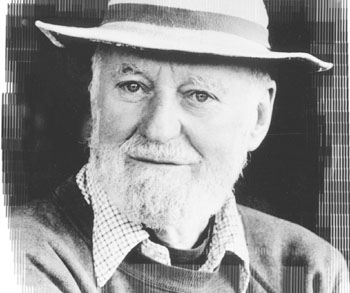
One of my favorite poets, Philip Levine, has just been made Poet Laureate of the United States. This makes me happy because I like him a lot.
When I first started reading poems, his stuck out from a lot of the other poems I was reading. They seemed to be written by guys and gals with upper-class backgrounds who went to high-class schools and seemed to write about stuff that really didn't enter into my world. We were working-class. My dad worked in a factory, and my mom cleaned offices in a skyscraper. When we got together over dinner, we didn't talk about Monet or Harvard or John Updike or Martha's Vineyard. We talked about how hot it was in the factory or about what kind of stuff the guys with Harvard educations were throwing into their office trashcans.
Philip Levine seemed to come from that world too. He was a working-class guy, and I always felt that his poems were about the world I lived in, a world of hard jobs, tough luck, dreams that kept us going, and families that fought to stay together but sometimes couldn't. I also liked his clarity. He was like all my favorite poets Whitman, Frost, Williams). He talked so that my mother and father, people with hardly any education at all, could understand.
He's written a lot of really good poems, and here are three of them that I like: "Detroit Grease Shop Poem," "The Simple Truth," and "Gospel."
Detroit Grease Shop Poem
Four bright steel crosses,
universal joints, plucked
out of the burlap sack --
"the heart of the drive train,"
the book says. Stars
on Lemon's wooden palm,
stars that must be capped,
rolled, and anointed,
that have their orders
and their commands as he
has his.
Under the blue
hesitant light another day
at Automotive
in the city of dreams.
We're all here to count
and be counted, Lemon,
Rosie, Eugene, Luis,
and me, too young to know
this is for keeps, pinning
on my apron, rolling up
my sleeves.
The roof leaks
from yesterday's rain,
the waters gather above us
waiting for one mistake.
When a drop falls on Lemon's
corded arm, he looks at it
as though it were something
rare or mysterious
like a drop of water or
a single lucid meteor
fallen slowly from
nowhere and burning on
his skin like a tear.
The Simple Truth
I bought a dollar and a half's worth of small red potatoes,
took them home, boiled them in their jackets
and ate them for dinner with a little butter and salt.
Then I walked through the dried fields
on the edge of town. In middle June the light
hung on in the dark furrows at my feet,
and in the mountain oaks overhead the birds
were gathering for the night, the jays and mockers
squawking back and forth, the finches still darting
into the dusty light. The woman who sold me
the potatoes was from Poland; she was someone
out of my childhood in a pink spangled sweater and sunglasses
praising the perfection of all her fruits and vegetables
at the road-side stand and urging me to taste
even the pale, raw sweet corn trucked all the way,
she swore, from New Jersey. "Eat, eat" she said,
"Even if you don't I'll say you did."
Some things
you know all your life. They are so simple and true
they must be said without elegance, meter and rhyme,
they must be laid on the table beside the salt shaker,
the glass of water, the absence of light gathering
in the shadows of picture frames, they must be
naked and alone, they must stand for themselves.
My friend Henri and I arrived at this together in 1965
before I went away, before he began to kill himself,
and the two of us to betray our love. Can you taste
what I'm saying? It is onions or potatoes, a pinch
of simple salt, the wealth of melting butter, it is obvious,
it stays in the back of your throat like a truth
you never uttered because the time was always wrong,
it stays there for the rest of your life, unspoken,
made of that dirt we call earth, the metal we call salt,
in a form we have no words for, and you live on it.
Gospel
The new grass rising in the hills,
the cows loitering in the morning chill,
a dozen or more old browns hidden
in the shadows of the cottonwoods
beside the streambed. I go higher
to where the road gives up and there's
only a faint path strewn with lupine
between the mountain oaks. I don't
ask myself what I'm looking for.
I didn't come for answers
to a place like this, I came to walk
on the earth, still cold, still silent.
Still ungiving, I've said to myself,
although it greets me with last year's
dead thistles and this year's
hard spines, early blooming
wild onions, the curling remains
of spider's cloth. What did I bring
to the dance? In my back pocket
a crushed letter from a woman
I've never met bearing bad news
I can do nothing about. So I wander
these woods half sightless while
a west wind picks up in the trees
clustered above. The pines make
a music like no other, rising and
falling like a distant surf at night
that calms the darkness before
first light. "Soughing" we call it, from
Old English, no less. How weightless
words are when nothing will do.
______________________________
You can find out more about Philip Levine and read some of his poems at the Poets.Org site. Just click
here.
The best source for his poetry online is the Contemporary American Poetry Archive. Just
click here and you will be amazed.










 Posts
Posts


