Saturday, March 01, 2008

Solitude

Solitude?

Someone should write a history of it.

Think about it. Probably for the first million plus years we were here on earth, we were up to our ears in solitude. We'd watched the sky and the horizon for a bit of smoke, listen for the turning of a clumsy wheel or a whistle coming from some tall grass. Anything that might signal that our solitude was about to end.


At night, we'd sit in a tree or a cave and practice our smiles and handshakes on the off chance we'd meet somebody the next day coming toward us through that grass. We'd also practice our “company’s coming” talk, "Hi, I'm Abel from this tree here, glad to meet you. You just passing through? Like to stop?"

Sometimes you see a bird all alone on a tree, turning his head this way and that, pausing and listening the way birds listen to the sounds in the wind when they're all alone. We were probably like that bird most of the time we were on earth--maybe up to about 15,000 years ago when we learned to hunker down together.

It was probably a good break from the solitude and what was behind it and always coming closer, the loneliness.

A person gets tired of sleeping with his back exposed to the wind and the weather. He wants to have someone behind him keeping his back warm. It was probably that way when he was a baby, his momma pressing his back into her warm belly. You miss that kind of loving and go searching for something that will break the loneliness and the fancy Sunday-dress version of loneliness, solitude.


But then something happens, and we start getting a little too much of that pressing.

Maybe it's the growth of cities or the rise of the merchant class or the start of the industrial revolution with its ugly factories, and all we got then is people pressing into us, some pressing in a loving way but more just pressing, just pressing a little more each day until we start thinking down into our DNA and remembering the solitude we had so much of so long ago, and we start missing it.


(Photos: The first photo of a field in Illinois is by the poet and photographer Michael Healey. The photo of Walden Pond 2007 and the Bellagio Casino/Las Vegas 2007 are by me.)

Thursday, February 14, 2008

AWP 2008 Update!

After I wrote my previous blog about the AWP, I started hearing from people I saw or didn’t see at the conference, and I started remembering stuff I wished I had put in the previous blog, but early on I promised myself I would never revise blogs. Period means period.

So I’m getting around that promise by doing another blog.

First, I wanted to mention the people that I saw that I didn’t mention earlier.

My first AWP blog made it sound like I was pretty lonely there (and I was), but that probably had as much to do with my own general gloominess as it did the conference. Beside all the people I did mention in the previous blog, I saw two others I wanted to get in.


I ran into David Radavich, one of my EIU friends, about five times at the AWP Bookfair. He was usually going one way and I was going another. We nodded and shook hands and said this and that, but I guess I was too discombobulated to say to David, “I’m lost, let’s have coffee.”

I also ran into Thad Rutkowski who I recently read with in DC. We did have coffee (Starbucks) and talked about how confusing the conference was. He gave me a copy of his book Tetched: A Novel in Fractals.

(If you are reading this and saw me or talked to me at AWP, please drop me a line at jzguzlowski [at] gmail.com, and I will be sure to post your name in my next AWP update.)


Then there are all the friends who I didn’t see but who I found out later were there: Jean Braithwaite, Irene Willis, Sheryl St. Germain, and Jeff Vasseur.

I ran into Jeff at La Guardia Airport when I was heading back to Valdosta. I said, “I didn’t know you were at the AWP,” and he said, “I didn’t know you were at the AWP.” We grinned and shrugged, and talked about the general confusion at the conference; and then he said something that really stuck with me. He said (and I’m paraphrasing here), “Being at the AWP is like being on Mars.”

I’ve thought about that a lot and figure that that gets to the heart of it as well as anything. It’s like we’re astronauts in separate little personal rockets aimed at Mars, and NASA hurls our souls – as Bruce Springsteen would sing it – into that “great void” beyond, and some how most of us make it, and then we start wandering around Mars looking for other little personal rockets with poets and writers inside.

We find some of those other astronauts but others we don’t. It’s a big dusty planet, and we have other things on our mind.

And of course some of us don’t make it to Mars.

Friday, February 08, 2008

AWP: Associated Writing Programs Conference 2008

I went to the AWP Conference last week.

I wasn’t going to go at first because I don’t much like conferences. But I started ticking off the reasons I should go: I had published two books of poems in 2007, and I had the chance to do book signings for both, and I was looking for an agent for the novel I’m working on and somebody told me that agents at the AWP were as thick and friendly as kittens. So I paid my $200 membership/registration and booked my $300 airplane ticket, and packed up my books and set off.

The conference turned out in a lot of ways not to be the conference I had imagined it would be.

I was all fired up about seeing and hearing some of my favorite writers, but circumstances way-laid me or way-laid them:

A. S. Byatt got really sick so she didn't read. Louise Gluck broke her wrist so she didn't read. E. L. Doctorow didn't show up so he didn't read. Martin Amis and John Irving were on at 830 pm on different evenings. They did read but I was in bed by then and didn’t hear them read. Frank McCourt and Billy Collins and Cynthia Ozick were all reading at the same time while I was watching John Surowiecki’s great one-act play “My Nose and Me” (A TragedyLite or TradiDelight in 33 Scenes) about a nose that gets skin cancer.
.
Then there were all the events that I screwed up because I got the times wrong:
Stuart Dybek's talk about Richard Yates, Carolyn Forche's reading from her new book, Joyce Carol Oates' reading from whatever she read from, Marian K. Shapiro's book signing, the Blood to Remember: American Poets on the Holocaust reading, a panel on how writers use memory.

And that list goes on and on.

Then there were all the events I went to that I wished I hadn't:

--one well-known poet reading his flat poems about Asia

--an older poet who didn’t seem to know much about grief and faith reading poems about grief and faith

--another older poet reading poems about national security and the homeland etc that wanted to be ironic and satirical but weren't.

But mostly what I did was wander around the three floors of book stalls trying to find the next session.


When I wasn't doing that, I was sitting at either the Steel Toe Books table or the Finishing Line table. I spent a lot of time at those tables, and really that time was one of the highlights of the conference. There were 8000 writers at the conference, and amid all that talk and scurrying a guy can get worn down shorter than a pencil nub unless he can find some place to sit and take life and writers as they come--one by one.

I did that at the Steel Toe table and the Finishing Line table.

I met some nice people at both of them and had good conversations about books and writing: I talked to Leah Maines, Katie Hae Ryun Leo, Dale Sprowl, Elizabeth Bradford, Bill Zavatsky, Robert Cooperman, J. C. Todd, Amy Groshek, Sean Conrey, Jason Lee Brown, Mary Biddinger, Lisa Siedlarz, Karen Zabarowski Duffy, and the essential Tom C. Hunley -- and I sold and signed some books too!

And there were some other moments that I wouldn’t have missed:

Really, I would go again just for the goof of going up an escalator and watching Billy Collins decide between buying some book that I can't identify from 20 feet away and some other book I can't identify no matter how hard I try.

Or how about when I went up to some famous poet and told him I was a friend of a friend, and he thought I was the guy who was supposed to take him to his next session. He started following me and then when he realized that I didn't know where he was supposed to go, he had to figure out where he had been. It wasn’t easy.

Or how about when I saw Joyce Carol Oates being smuggled out of the Hilton Hotel in what seemed like a disguise. It was a floor-length red/maroon plaid cloth coat (what used to be called a maxi) and a matching floppy hat. It was the same shape as the one Ingrid Bergman wore in Casablanca, but a totally different color/pattern. Wilder by half!

Or how about running into one of my favorite people, the poet Charles Fishman, and having a funny conversation with him about pretzels.

Or how about when I had that enormous bowl of Chinese vegetable and noodles soup with my Valdosta friend Marty Williams.


Or how when I saw two old friends I hadn’t seen in too long: Lola Haskins and Gray Jacobik.

That was the best part.

Sunday, January 20, 2008

My Mother's Optimism

My Mom had two bouts of cancer in her last years.
.
First, she had breast cancer and a couple of years later she had ovarian cancer. For about five years, it seemed like all of her life was surgery, radiation, and chemo-therapy.
.
While she was recovering from the second cancer, I wrote a poem about her experience, and it appears in my book about my parents, Lighning and Ashes.
.
Recently, the poem was republished by The Survivor's Review, an online journal for and about cancer survivors.

I thought you might like to see the poem and maybe take a look at some of the other poems and stories there.
.
Here's the link:
.


Thursday, December 27, 2007

Garrison Keillor's Writers Almanac: "What My Father Believed"

Garrison Keillor's reading of my poem "What My Father Believed" from my book Lightning and Ashes is now available at the Writers Almanac site:

http://writersalmanac.publicradio.org/programs/2007/12/24/#friday

This poem talks about my father's faith, how he learned about God in Poland as a child, and how his faith sustained him in the concentration camps in Nazi Germany.

Friday, December 21, 2007

Merry Christmas and Happy 2008 to All our Friends and Family!

I’m back writing the Christmas letter this year. Linda filled in for me last year, and she received a lot of excellent reviews, and in the past three or four weeks, she’s received letters asking her to continue doing the Guzillo Christmas letter. A lot of these letters came following her recent blog about pecan picking in Georgia. But we made a deal last year, so I’m back doing it this year.
.


I want to mention first that Linda’s Uncle Charlie died in August. Some of you who’ve read my blogs about him know he had pancreatic cancer that grew increasingly bad over the summer. Linda and I drove down to Florida a number of times to be with him and help him as his condition got worse. He died quietly in his sleep on August 24th. We’ll miss him.

Linda’s big news is that she’s decided to retire as of July 1, 2008. She’s been envying how laidback I’ve been since I retired, and she finally turned in her letter. I’ve noticed already that she seems more laidback than before. In fact, our cat Samantha has been spending more time sleeping on her stomach than on mine. I may have to get my own cat if Linda gets any more laidback.


Linda’s plans for our retirement? We hope to do more traveling. We’ve started talking about a big, long, two or three week cruise through the Panama Canal and up the boot of Baja, California, and out across the Pacific, maybe to Hawaii or maybe further to Tahiti or Thailand or Taiwan. Or maybe we’ll just stay here in the states and do a Casino Crawl from Las Vegas to Henderson to Reno and Winnemucca, Nevada.

By the way, she wanted me to tell you all that the pecan picking this year has been superb. Bigger nuts and more of them! She thinks it may have something to do with the presidential primaries that are coming up.


Lillian continues to enjoy teaching in Danville. This is her fourth year at George Washington High, and she’s recently been tenured. Like her mom, Lillian is interested in going beyond the classroom. She’s been commuting to Lynchburg College two or three nights a week this year, where she’s been working on her Master’s in Educational Leadership. This coming May she’ll be getting that Master’s. By the way, this last summer, she served as principal at her high school! She expelled five students!

I’ve been focusing on my writing. I published Lightning and Ashes and Third Winter of War. The latter was nominated for the Pulitzer Prize in Poetry. Right now, I’m working on a novel about a German soldier in Russia during WWII. Joyce Carol Oates published the first chapter in her journal Ontario Review. I’m also blogging as fast as I can and doing presentations about my parents all over the place, and if you read this before December 28 you can hear Garrison Keillor reading my poem “What My Father Believed” on NPR’s Writer’s Almanac.


Love from us to you,

Linda and John
.
.
(the photos? First it's a plate of Christmas bulbs, then Linda and her brother Bruce, then Lillian, then my sister Donna and me in a refugee camp in Germany.)

Tuesday, November 27, 2007

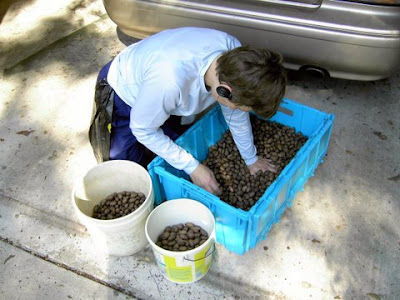
Pecan Picking Time in Georgia--Guest Starring Linda Calendrillo!

My wife Linda showed me a letter that she was sending to her nephew Matt Calendrillo and his wife Katie, and I said, "Linda, this has to be a blog!" Linda was sceptical.

All she had done, she said, was write a letter to Matt and Katie thanking them for sending her some nuts that they picked near their home in Pennsylvania.
.
I said, "No. It's more than that. It's perfect blog material about something you love--Pecan Picking."
.
She looked at me and said, "Well, you're the one famous for blogging. Go ahead."


Here's the letter she wrote:


Dear Katie and Matt,

How can it be that it's taken me so long to thank you for your nuts?!? First, I had a problem finding your email addresses. Then, I lost your phone number, so that plan went belly up. But I finally found your email address.
.
So back to the nuts.
.
PA nuts are scrawny compared to GA nuts (GA squirrels are scrawny compared to PA squirrels, so all this makes no sense to me), but nuts are nuts and we did enjoy investigating the ones you sent and eating them. Are you still picking them up? Is the later crop bigger? Thinner shelled (boy, they were hard to crack)? Less oily?

We are having a boom year here and have big vats of nuts all over our garage. I am hoping John will make the trip today to sell nuts and have other nuts cracked and blown. In GA, we have odd little seasonal businesses that set up to prep nuts for individuals. We pay around 50 cents a pound to have the nuts cracked and blown so that we can then easily separate the shells from the meat of the nut to freeze them.

You can imagine that we're talking volume here. I bet we'll have around 20 pounds cracked today. We had 12 pounds cracked a couple of weeks ago.

When we get the pecans after they've been cracked and blown, they come to us in two paper sacks. In one bag, there are mostly nuts. In the other bag, there are mostly shells. The job comes in when we need to separate the nuts from the shells. Separating the nuts from the shells is important work. If we're not careful, we get shells in the cookies and crunch down on shells when we eat a handful of nuts as a snack.


I'm giving you this background in the hopes that as kindred nut-picking spirits you'll be able to share the wild ways of the PA nut traditions.

We also have large businesses that buy nuts from us locals and sell them to Northerners (known here as yankees, with a derisive slur). These businesses pay us about 50 cents a pound, and I suspect we'll have well over a hundred pounds to sell today. Our biggest year was 400 pounds.

We may hit that this year again if John and I can keep our backs in working order. Bending down to pick up pecans is not for babies!

In fact, working with pecans is work!

Saturday, I spent three hours on the roof of our garage harvesting nuts, by the way. If you have a roof, with nut trees overhanging it, you might consider going up there to check out your crop.

So much for nuts.

I need to get back to work.

Love,

Aunt Linda

Friday, November 16, 2007

The Skies Over America by Matt Flumerfelt

I read a lot of poems and meet a lot of poets, and one poet whose voice always moves me and excites me is Matt Flumerfelt. He's a poet who will open your eyes and get you thinking and feeling.


THE SKIES OVER AMERICA


The skies over America

are vibrant as a Pollock painting

and dissonant as a Schoenberg

symphony. They’re the canvas

on which we scrawl the graffiti

of our lives.

.

Ours is a garden where

every flower may flourish,

bitter nightshade and evening

primrose, a Mendelian greenhouse

where hybrids are the rule

and whore lies down with priest.

.

We’re enamored of the camera.

If we could, we’d like to film

the destruction of the world,

even though no one would be left

to watch it explode a second time

except a few seagulls.

.

America was born to immigrant

parents in a sharecropper’s shack.

Three acres and a mule were its

only possessions. It was suckled

on hard work, cheap whiskey,

tobacco, cornbread and collard greens,

and the promise of eternal life.

.

The skies over America

are crumbling. They’re responding

well to therapy. They need

more antioxidants, plastic surgery,

yoga lessons. They’re weeping.

The skies over America are

closed for remodeling.


---------------------------------------------------------------------------------

Matt's poem "The Skies Over America" is from his new book The Art of Dreaming.

It's available for $10, plus $2 for shipping.

You can order The Art of Dreaming from him at

29 loganberryCircle

Valdosta Ga 31602
.
Or you can email Matt at mattflumerfelt@bellsouth.net

Thursday, November 01, 2007

Valdosta Halloween--2007

We had 4 kids stop by for tricks or treats, a pirate, a witch, a batman, and a kid who didn't know what he was dressed as.


The pirate kid was proud of his costume even though he didn't have a hat or wig. He left them in the car his mom was using to drive him from one house to another. He said, "It's just too hot for a wig. That's why I'm not wearing one!" We gave him a quarter.

This pirate boy stopped by at about 7 pm.

After that, it was quiet.

At about 730, I went outside and stood on the front porch for a while to see if there was anyone coming. There was no moon yet, and all the houses on both sides of the street were dark. A car drove past going west toward the Walmart near I-75.

I looked across the street at the house where these 3 young girls live. It's a big old Victorian just like ours. Every year we've been in Valdosta, the girls have made it over--even when the youngest was 1. She wore a white and gold princess costume that year, and had her big white cat with her. The cat didn't wear a costume.

This year they didn't make it.

Their house was dark.

Thursday, October 11, 2007

Simple Polish Soup

A couple of days ago I got a Recipe Chain e-Letter. Don't ask me to explain how it works. It was so complicated that I was going to just delete the thing, but when I told Marty Williams that's what I was going to do, he said, "Just write out a simple recipe and send it to Tania Rochelle and be done with it."

I like Tania. She's a good person and a good poet, so I said I would.

Here's the recipe I sent her:

Hi, Tania,

I'm no good at cooking, so I can't vouch for anything I say about recipes or food or putting stuff on the table. I commuted for 8 years, was away from my wife for 2-3-4 days at a time, made my own food and everyday I ate the same thing, a micro waved veggie burger and a can of Progresso minestrone soup.

Having said that, let me say that the following is a real recipe.

Here it goes:

When my mother was in her late 70s, she couldn't cook for herself any more. Her heart and her back had both given out, and she couldn't stand for more than a minute or two. When you can't stand, you can't cook.

She started having her meals brought in by a charitable organization in Sun City, Arizona, where she lived after my dad died. This food was pretty miserable: Salisbury Steaks, tuna salad sandwiches, little cups of salad, vanilla cup cakes--stuff like that, five days a week. They would bring a white bag of this everyday around noon, and it was expected to last her through lunch and dinner. On the weekends she was on her own. She would have a friend bring her some chicken from KFC or a piece of cooked ham from the deli section at the Safeway Supermarket down the street. She would microwave this food Saturday and Sunday. Monday, she would wait for the guy from Meals on Wheels to bring her another bag of ham salad or egg salad sandwiches.

It was like this for about four years.

She didn't complain much, except about the tuna salad. She had a gallbladder problem and the onions in the tuna salad were hard on her gall bladder. She would try to pick the tiny shards of onion out of the tuna salad, but this got harder and harder as her eye sight gave out. (When she finally died, it was after a gall bladder operation. She survived the operation, but she had a stroke afterward that shut down her whole body. But that's another story.)


Anyway, when I would come to visit, she was always happy to see me because she could always talk me into cooking for her. I hate to cook and I hated to work around my mother. My mother learned discipline from the Nazi guards in the concentration camps. She expected you to follow orders and she expected you to do it right. There was no screwing up allowed around her. If you did, she would freeze you out, turn her sarcasm against you. Call you a baby or a fool. Tell you that you're a college professor and still you can't boil a stinking egg!

Like I said, I hated to work with and around her, but I cooked for her. She knew I was a fool with my hands, that I couldn't make the things she really wanted to eat like pierogi or golumpky, but she also knew that she could maybe talk me through some simple dishes. Navy Bean Soup was the one she had me make most often.

We would start making the soup the night before by putting the beans in a pot full of a couple quarts of water. This would have to soak overnight. The first time she had me make it, I asked her why I just couldn’t follow the directions on the package, and let the beans soak under boiling water for a couple hours on the day we were going to make the soup. She just looked at me.

Then the next day, the day we were actually going to make the soup, we would start early in the morning, so that the soup would be ready for lunch.

I would chop up about four good sized onions. They had to be chopped really fine because of my mother’s gallbladder problem. As I would chop, she would watch from her wheel chair. Some times she would think a chunk was too big, and she would point it out. “There, that one!” she would say. “Are you trying to kill me?” And I would chop it some more with this old, skinny bladed knife of hers that she had been honing for 30 years, just a honed wire stuck in a dirty yellow plastic handle.

Then I’d fry up the onions in about 4 tablespoons of butter. I’d fry them until they were caramelized, just a sort of hot brown jelly with an oniony smell. This would take abut an hour. Meanwhile, I would be chopping up everything else, half a pound of carrots, two or three pounds of any kind of potato, 3-4 stalks of celery. It didn’t matter how I chopped those up. My mother’s stomach had no trouble with them. It was just the onions that were a problem. So I chopped everything else pretty rough. I like big chunks of stuff in my soup.

I would take these chopped vegetables and add them to the frying onions and cook and stir all of that for about ten minutes on a low flame. Next, I would add the beans and the water they were in, along with too much pepper and salt. At this point my mother would stop watching me. She would figure that there’s no kind of damage I could do to the soup, so she would wheel her wheelchair out of that tight little kitchen and into the living room where she would turn on the TV, The Oprah Winfrey Show or the Noon News or anything else except soap operas. She hated soap operas, all that talk and people who were worried about stupid things.

I’d cook the soup for about an hour, maybe longer, and then I would carry a really large blue bowl of that hot navy bean soup to her and place it on her TV tray. She always said that she liked to eat like an American, on a TV tray So while I was finishing up in the kitchen, she would drag the TV tray up to her wheelchair, and she would ask me to put the soup right there.

I would and as soon as I did she would start crumbling saltine crackers into the soup. They were the final touch.

We would eat this soup just about twice every day I was visiting, lunch and dinner. If we ran out, I would make some more. It was better than the stuff my mom got from Meals on Wheels.

Wednesday, October 03, 2007

Poet Gabor Zsille Asks, What's Up?

I got a letter a few days ago from Gabor Zsille, a fine Hungarian poet and translator living in Budapest, and he asked me if there was something wrong. He hadn't heard from me in a long time.


Here's a photo of Gabor, and the letter I wrote back to him. I thought it would serve as a sort of explanation of what I have and haven't been doing this month.


Dear Gabor, I apologize for not writing sooner.

Three weeks ago I started doing a series of poetry readings across three states: Georgia, Kentucky, Illinois.

I drove approximately 1800 miles (3000 kilometers?). I read my poems about my parents, and I talked about their lives. It was a very good experience but that kind of travel is always harder than I want it to be. Sometimes I stayed with friends, sometimes I stayed in hotels. Always I was eating sweet heavy food that I shouldn't have been eating and drinking too much coffee and -- promise not to tell anyone -- even smoking a cigarette. Plus, I was seeing old friends who I've known for 30 years but haven't seen in 3 since I retired and moved down to south Georgia.

On top of all that I was not getting my usual exercise, no running or biking or walking or pilates or yoga. I gained 15 pounds over the summer while I was helping care for my wife's dying Uncle Charlie, and that weight sits heavy between me and the laptop on my knees.

On top of all of that I was reading poems aloud about my parents in front of groups large (300 people at the Women's and Gender Studies reading at Valdosta State University) and small (15 students in a class room on the fourth floor of Cherry Hall at Western Kentucky University), reading poems about all of that 20th century sadness, the kingdom of death, the slave labor camps, the concentrations camps, the sisters ripping their legs apart on broken glass as they fled the Germans, gypsy girls burning up like straw, all of that bad chemistry at the heart of the last century.

I got back home last Saturday night after a 14 hour, 800 mile drive. Since then I've been trying to get back to normal. I'm teaching an online creative writing class and had to catch up with all of students and their poetry projects. Teaching an online class gives both teachers and students a certain degree of freedom, but finally work has to be done, suggestions made, stanzas lengthened!

In addition, I have chores to do that you wouldn't believe. We live in a house that's 115 years old, and something is always falling down or falling apart and needing to be hammered back up! (I'm not going to tell you about my work on our swimming pool pumping system because you'll think I'm too middle-class, too bourgeois. Also, please don't mention the falling down part. We're trying to sell the house.)

And today, I volunteered to leave behind my students, my exercise, and my chores to drive with her to a meeting she has to attend in Macon, Georgia--home of Little Richard.

(Do you know Little Richard? He's the man. Here's a you tube of him singing "Tutti Frutti."
http://www.youtube.com/watch?v=6ayNdjFyk1c Have you read his autobiography? It's amazing. A black gay man growing up in the middle of straight, disapproving Georgia in the 1940s and 1950s!)

My wife Linda’s an administrator at Valdosta State University in south Georgia, and she has to periodically attend these meetings. And when she does I like to drive her. She's a fine driver, but I just like to drive. In fact, she's a terrific driver. She taught me how to drive (and how to swim) the first year we were married. She said, "Honey, I don't want to be married to a man who can't swim and drive!"

So while she goes to her boring meetings that determine nothing (I didn't say that) but do give the administrators an excuse to get out of town and eat some bad food and probably smoke cigarettes and drink a little white wine over dinner, I wander around these cities, poking my long Polish nose into alleys and side streets, sniffing like a blind man for some historical spot that will bring all of that crazy Georgia past to me like some kind of Proustian madelaine.

And how are you, my friend Gabor?

The weather here is dreadful. 90 degrees in the day. Steamy. The sun nailed in the sky.

And the nights?

Don't ask.

john

PS: did you receive the books I sent?

Tuesday, September 25, 2007

God Drunk

The novel Gilead by Marilynne Robinson is pretty great. (She also wrote one of my other favorite novels: Housekeeping.)


The voice in Gilead is wonderfully convincing. The narrator is a minister in his 70’s who’s got a bad heart and is writing to his 7 year old son who will never probably be able to know his father really, know what his father was like. So the minister starts telling his life story which involves telling about his father who was also a minister and his grandfather who was also a minister, one who rode with the abolitionist John Brown. The book is a sort of history of religion in America across the last 150 years, talking about Karl Barth and Sartre, and talking about how God gave the American people visions back then to encourage us to break the chains that bound the Africans to the mud of slavery.

And this novel also gives a beautiful evocation of life in Kansas and Iowa since the middle of the 19th century. Robinson, who's from small town Idaho I believe, really knows how to write down what it's like to live the kind of quiet life you get in places like Charleston, Illinois, a town I lived in for 25 years. The minister's son in the novel is 7 years old in 1956. So, for me, there are also lots of charming moments that remind me of my growing up. The boy’s watching the Cisco Kid (one of my favorites) on a tiny TV set, going to movie theaters to see movies about US Marshalls in wide brimmed sombreros rounding up bad guys riding hard-tracking mustangs, etc. It does take me back.

I like the history and the prairieness and the popular culture references a lot, but I’m not sure what I make of the novel finally. It is so Christian, so God taken and God drunk. I figure that maybe Robinson is arguing that Christianity should return itself to the sort of humility it had at some point in the past when it was beset by existentialism. But I’m not sure if Christianity ever had that sort of humility. I know that the Catholicism I knew in the 50’s was never humble. It was pretty muscular. The Pope was a sort of ecclesiastical Uncle Sam rolling his sleeves back to punch the God-cursing Commie specter of Joe Stalin in the nose.

Are there any humble religions? I know there are humble people inside (and outside) religions, but humble religions? Self effacing religions? Head bowing religions?

I'm not sure.


(That's a picture of Marilynne Robinson back in 2005 when she won the Pulitzer for Gilead. If you want to read some reviews of the book, you can click on the link on the right margin of this page, toward the bottom.)

Wednesday, September 12, 2007

Update on "The Short View"

I’m getting a lot of comments about the blog I posted yesterday about Sept. 11. Some of them were sent into the comments space, and some have come directly to me. I’ve tried to encourage the folks who sent directly to me to post to the comment space, or let me post for them. I’ve succeeded in some cases, but not in others.

The comments have generally been of two kinds. There are the people who wrote in and said they too were thinking about where they were and what their friends were doing that day in 2001. Some of them wrote about the friends they had lost. These are the people who, I guess, felt the way I did yesterday.

For me, it was a day of mourning and remembering the trauma that ripped through my family. My wife Linda’s from Brooklyn, and she has a lot of relatives in the New York area. We were both thinking about them yesterday, and thinking too about their friends and their friends’ friends, all that wide and complex set of connections we all worried about on 9/11 and the weeks after.

Like I said, it was a day of mourning for me, and I think it was a day of mourning too for some of the people who wrote in and told about their friends and family.

The other letters I got were from the people who felt that this anniversary of 9/11 called for something more than mourning. These letters suggested that the kind of emotions I was talking about in my piece “The Short View” were the kind of emotions that have gotten us into trouble politically, militarily, socially, and culturally. These letters suggested that politicians use the kind of emotions I was showing to their own ends, and that in this case, the ends were terrible, the continuation of a war in which there are more and more deaths each day with little accomplished and less in sight.

I really can’t argue with that bleak assessment of the war. The deaths are in fact terrible. I haven’t done much research but I’ve done some, and the numbers of dead and wounded suggest that there are a lot of people here and in Iraq who are mourning.

As of today, the Iraqi military and civilian death count since 2005 when the Iraqi Coalition Casaulties site (
http://icasualties.org/oif/default.aspx) started counting is about 43,000. That’s about 37,000 Iraqi civilians.

As of September 10, 2007, the site reports 3,765 confirmed US military deaths with 9 pending confirmation. The Department of Defense has confirmed a little less than 37,000 military people wounded or medically evacuated. The DoD also reports 122 US suicides.

I really don’t know how to begin thinking about all of the human cost in misery and pain. About 48,000 people dead and a country that’s been chopped up and blasted apart? I was talking to a mathematician yesterday, and she told me that a person generally can’t imagine more than a thousand of anything. 48,000 deaths of US and Coalition Forces and Iraqis? It’s difficult to imagine a number of dead people that high. And the number of wounded on both sides? And the number of people touched by those deaths and those wounds? That’s harder still to imagine.

How high is it? It’s hard to say, but I know I’ve had students who went to Iraq, fought and were wounded in Iraq. We all know people “on our side” touched by this war. I used to commute a lot when I was teaching in Illinois and living in Georgia. Every week, I would pass through the airport in Atlanta – it was full of soldiers going to Iraqi. The odds are that some of those boys and girls never saw the US again. And the numbers on the other side? Higher still. Higher still.

When I wrote the “Short View” piece in 2001, I was responding to that time and what was going on in America. Am I ready to give up the “Short View” and start thinking only about the “Long View”?

I don’t think so.

I’m not an either/or sort of person. I can’t say I’ll stop being emotional, taking the short view, and start being rational and take the long view. I tend to see things as both/and. I don’t know where that comes from, maybe from my parents who both went through the slave labor camps and came out two very different people, maybe it comes from growing up bi-lingual and bi-cultural and generally confused by how complicated the world is. Whatever the reason, I’m hesitant to pin myself down, choose one side or the other.

I can take the short view, feel grief and mourning, but I can also feel that we need to close the book on America and Iraq, just the way the British did in 1917 when they invaded the country and found themselves fighting a war they could never win, against a country that didn’t want to see anything of them except their backside.

Tuesday, September 11, 2007

The Short View and the 9/11 Terrorist Attacks

I got a letter on Sept. 12, 2001, from my friend Bill Anderson who tended to take a cynical view of people and government and the human animal in general. The following was the response I wrote to him that day:

I wish I could take the long view the way you do, Bill: look at the attack, and see it the way it probably is: Bush seeing this as his way of putting a lock on his second term, Americans showing their true nature by making money on increased gas prices, Hollywood being angry because this will put the next Bruce Willis film on hold for 2 weeks. The long view: we're all self-serving crooks.

I'm not good at the long view. I'm more of a short view guy: One of my wife Linda's cousins saw the first tower go down from her office. Her name is Lisa. She was a wonderfully fat baby. One time her mom, Linda's Aunt Anne, dressed her in a tutu, and Linda's dad Tony laughed and laughed, and still 25 years later the family talks about the tutu and how much we all loved her in her tutu and laughed with joy at her beauty.

Lisa got out okay. She was evacuated, and finally found herself across the river at a phone booth in Hoboken, New Jersey. She called home to Aunt Anne and Uncle Buddy. He’s also a short view guy: He was with Patton's soldiers when they freed the first concentration camps. He still shakes and cries when he remembers the piles of corpses.

My niece is an emergency room nurse at NYU hospital (I think I saw her in the background on an NBC spot about the hospital--but I wasn't sure. She looked old and tired and gray with pain). Her dad, Linda's brother Bruce, was calling her and calling her to make sure she was okay. Finally she got through to him late in the afternoon on Tuesday. He begged her to leave the hospital, said he would drive down from Connecticut and get her. Cried and begged her. He said he was her father and she had to listen to him. (Bruce isn't much of a crier. He's a jokey, tough Brooklyn guy.) But she was his baby and he wanted her away from all of it. And she said she couldn't leave. He cried some more and pleaded, and she hung up on him. She had to get back to work.

And all those people looking for their relatives and friends, holding pictures up to the TV cameras and telling us about how some guy was a great friend, and he was a waiter in a restaurant at the top of the building. And I see this picture of this poor foreign looking schmuck with a big nose and a dopey NY baseball cap that's way too big, who probably came here with a paper suitcase and thought that working up at that restaurant was the greatest thing possible in the world. And the friend hoping to find this guy thinks this guy is alive someplace, maybe in a coma in some hospital.

And I know there's not a chance in hell this guy or any other guy or gal in any of these pictures is alive. They're dead, all dead, but I wouldn't tell this guy holding the picture.

Boy, these are stories that touch me so hard I can't think about the other stuff, the long view.

Saturday, September 01, 2007

Upcoming Poetry Readings

I'll be doing some poetry readings over the next couple weeks and I thought I would mention them here and invite everybody to the readings. In all of the readings, I'll be reading from my two new books about my parents and their experiences in the slave labor camps.: Lightning and Ashes and Third Winter of War: Buchenwald.

The first reading is for the lecture series sponsored by the Women's and Gender Studies program at VSU. It will be at 7pm, Tuesday, Sept. 11 at the Bailey Science Center at Valdosta State University.

Here's some info about that and the entire series:

http://www.valdosta.edu/womenstudies/UpcomingEvents_000.shtml

The following week I'll be giving a reading at Western Kentucky University, at 7pm, Tuesday, Sept. 18.

The next day, I'll be reading my poems about my parents as part of the Eastern Illinois University conference on World War II and James Jones. The reading is at 3pm, Sept. 19, in the library.

Here's the website with further information:

http://evff.net/conference-schedule-tentative/

All of the above are free and open to the public, but if you can't come, you can hear and see me read on line. Janusz Zalewski and Henryk Gajewski put together a website of readings from the January 2007 PAHA conference.

Here's that link: http://gajewski.tv/poets/

Friday, August 24, 2007

Uncle Charlie, August 24

Uncle Charlie died this morning at 7 am.

So long, Charlie. We'll miss you.


Wednesday, August 22, 2007

Uncle Charlie, August 22

I haven't posted about Charlie for a couple of days because I guess I've just been waiting. Like him.

But Uncle Charlie is coming close.

Earlier, he was upset because he wasn't dead, and I think that was keeping him alive, contributing to his agitation and keeping him with us.

He really thought he was a goner at first. The doctors operated on him, looked at his pancreas and said, 3 weeks tops. One guy gave him a week. That was in mid May, and Charlie is still with us. But he just wants it to be over with. He didn't want chemo or radiation. He just wanted it to be over.

When the hospice started, he thought he would be dead in a week or so. The hospice nurses came to his house for the first few days and gave him hospice care there. This was hard for him because he was in a lot of pain and getting a lot of pain killers. When he asked to go to the actual hospice unit, he thought he would be dead in a day or two.

Then the dying just went on and on, and he just wanted to die. When he was awake and clear, he'd ask repeatedly if he could go home. He was sure that the hospice care was keeping him alive, and he didn't want to be alive any longer. That was Monday, the day I left Hollywood, Florida, and drove back up to Valdosta.

I talked to his brother Tony today, and he finally got someone to talk to him at the hospice. A nurse told him that she thought Charlie had another couple of days. Charlie's terminal agitation has stopped. He stopped talking too, even the raving that he was doing. He's lying tucked under a sheet--breathing hard, really hard, staggered, drawn breaths.

But life is hard to give up on.

When my mother was dying, she couldn't talk, couldn’t eat, couldn't move any part of her body. All she could do was blink her eyes, and I asked her if she wanted to die or if she wanted me to try to keep her alive. I told her to blink if she wanted to stay alive. She blinked.

Tuesday, August 21, 2007

Mike Rychlewski Talks about Dying

My friend Mike, a Chicago writer I’ve known for 40 years, wrote me a letter after reading some of my blogs about my wife Linda’s Uncle Charlie and his dying, and I thought I would pass on what he wrote. Ever since our days together as students at the U of I, Chicago, Mike has always been able to get to the center of things.

Here’s what he sent me about some of the people he loved who died:

Dying from burns over 70% of his body, my father flopped and flailed like someone getting shock treatment or being blasted in the chest with electric mittens. Two nurses were holding him down as he popped up and down.


My mom was lying on her bed in the nursing home with her back to the dark TV screen in the middle of the afternoon when there was a Cub game on. I asked her why she wasn't watching it--she had never missed a game--she said she wasn't interested.

My uncle got up from his bed at the nursing home, walked out the door, hailed a cab and took it ten miles across Denver. The found him that night wandering around the neighborhood he grew up in as a boy.

My other uncle sat on the edge of the hospice bed and took out an imaginary pack of cigarettes from his breast pocket, shook one out, reached into his front pocket for imaginary matches, pealed back the cover, lit the match, held it to the cigarette, took several puffs, finally got it going, and sat there for ten minutes smoking it. It was a performance that would have put Marcel Marceau to shame.

My bachelor cousin at 93 was lying in his gentleman's nursing home hospice room and his nephew from Virginia, who had been bearing witness for two months, finally had to go back to his wife. He said, "I’m leaving now, Mac." Mac said, "Wait!" and he summoned the nurses, insisted they dress him--he was the most elegant dresser I ever knew--he got on his white shirt, blue sport coat, gray slacks, silk tie, lapel handkerchief, spit-shine shoes, took off the oxygen and the IVs, slowly walked to the dining area and ordered the two of them tea and cake. They sat there and ate it. Mac said, "This is what I want your last memory of me to be."

.
There's no meaning, no purpose, no hidden agenda.
.
No one's death is more or less dramatic or poignant.
.
There is no scheme to the universe and we're neither less nor more than nothing.
.
The love of the people we know.
.
Period.
.
If you don't have it, God have mercy on your soul.


[The photo above is of Mike at the graves of his Mother and Father, St. Adalbert's Cemetery, Niles, Illinois, Summer 2005. My parents are buried here also.]

Saturday, August 18, 2007

Hospice, August 17

When we went to the hospice today, Charlie was in another room. The nurses had moved him because he kept trying to get out of bed in his old room. The new room was right next to the nurses’ station, so they could keep track of him better. The could keep an eye on him all the time so he wouldn’t try to get up out of bed and start heading home.

But there didn’t seem much chance of that. Lying in his bed, he seemed quieter, the terminal agitation and restlessness had stopped. Charlie looked at his brother Tony and didn’t move—it was like Charlie was surprised we were there and didn’t have the words or energy to tell us what was going on.

After a minute, he said, "I had a strange experience today." And he tried to tell us about a dream that he had, but he wanted us to know that it wasn’t a dream but that it had really happened, and he wanted us to say that we believed him when he said it really happened. And I said I believed him, and I told Tony who couldn’t hear very well to say that he believed, and he looked at me with a question and then he said he believed.

The story Charlie told was confusing. It must have been some kind of half dream half waking reality that he experienced, and what made it hard for me to understand his story was that I could hear some of what he said but not other parts.

The story was about his home, and somebody trying to take his home away from him, and this person was a communist and a guitar player, and she tried to get the house from him for $99 but he fought her off. He wouldn’t sell no matter what terrible things she did to him, and he kept talking about the way she tried to get him to sell, offering more money and less money and then more money again. And during all of this pressure to sell, Charlie saw above and behind her head these messages that appeared in different colors, yellow and blue and red, and I asked him what the messages meant. He couldn’t tell us because he couldn’t read the messages but he knew that he wouldn’t sell the house for $99 or $77 no matter what she said or what terrible things she did.

And then he stopped talking and asked if I understood. I said I did. I had read in one of those hospice pamphlets that they have lying around here that you should agree with whatever the dying say, so I said I did. And the pamphlet must be right because he seemed happy that I understood. And really, I think I did understand.

Charlie then said, "Give me a hand," and I thought, Oh oh, he’s going to try to get out of bed and that’s just what he started doing -- his feet started moving to the edge of the bed and he gripped the bed rail and started pulling himself up. And I thought, the terminal agitation’s back.

Tony called the nurse, and she came in, and I thought she would try to put Charlie push back into the bed but she didn’t. She helped him out of the bed; she helped him get his feet in his red socks on the floor – and when she had him standing, she held his arms while he took a step and then another toward the bathroom. It was a miracle.

I had to get out of the room – it was too much, and I went into the lobby and sat down. Five minutes later, Tony wheeled his brother out of the room in a wheel chair. They took a spin around the room and went into the dining area and Charlie sat looking out the window toward Pembroke Ave and the north side of Fort Lauderdale.

The gigantic white and blue clouds lifted off the horizon and rose to the rich blue at the top of the sky. It was the kind of day that probably set kids dreaming about visiting Tahiti or Fuji or the islands Herman Melville visited as a boy when the 19th century was still a kid and people traveled across oceans on sailing ships that were like clouds anchored to clean-planed oak planks.

After a while he said he was tired, and Tony wheeled him back into his room, and he and I helped Charlie get out of the chair and into the bed.

As soon as he laid his head down on the white pillow he fell asleep.

Thursday, August 16, 2007

Terminal Agitation, The Hospice, August 14

When Linda told me that the nurse said Uncle Charlie was terminally agitated, I thought she was joking. It reminded me of old washing machines with their agitators and the talk of communist agitators during the 60s and what the old Italians call giving someone "agita." Agitation seemed like such a funny and soft word to describe anything to do with death and the hard facts of dying.

But the nurse said she wasn’t joking and after Linda got off the phone with her, we googled "terminal agitation" and there it was, on a page dealing with hospices.

Here’s what we read:

What is Terminal Restlessness or Agitation?

Those who work with the dying know this type of restlessness or agitation almost immediately. However, the public and patient's family may have no idea what is going on and often become quite alarmed at their loved one's condition. What does it look like? Although it varies somewhat in each patient, there are common themes that are seen over and over again.

Patients may be too weak to walk or stand, but they insist on getting up from the bed to the chair, or from the chair back to the bed. Whatever position they are in, they complain they are not comfortable and demand to change positions, even if pain is well managed. They may yell out using uncharacteristic language, sometimes angrily accusing others around them. They appear extremely agitated and may not be objective about their own condition. They may be hallucinating, having psychotic episodes and be totally "out of control." At these times, the patient's safety is seriously threatened.

Some patients may demand to go to the hospital emergency room, even though there is nothing that can be done for them there. Some patients may insist that the police be called ... that someone unseen is trying to harm them. Some patients may not recognize those around them, confusing them with other people. They may act as if they were living in the past, confronting an old enemy.


I got that from the Hospice Patients Alliance. Here’s there link:

http://www.hospicepatients.org/terminal-agitation.html

But that didn’t come near describing what Charlie was going through.

He wanted so bad to get out of bed and stand up and walk out of the hospital that no word from Tony or the Nurses or the doctor could turn him aside. Charlie wanted to be on his feet and moving toward the door, and more than that. He wanted to walk out the door to the elevator and take the elevator downstairs and then walk into the parking lot and get into his candy-apple red 98 Mercury Sable and drive away from this hospice like a man being chased by the devil.

But he wasn’t going anywhere, even though he moved his feet toward the foot of the bed and he tried to grab the bed rails with his hands and pull himself up. He tried that over and over. You’d put his feet under the sheets, and he would try to lift his shoulders up off the bed. You’d tell him that he couldn’t lift himself up, and he’d try moving his feet toward the edge of the bed. And all the while he’d be talking about leaving the bed and getting stronger and walking out of the hospital. He’s spent days trying to get out of bed and telling us he was feeling fine and was ready to go home—even though he was down to 80 pounds and his skin and eyes were a sandy yellow color.

And when he wasn’t talking about how good he felt, he talked about people he had to call and things he needed to do, the projects he was working on and the places he needed to shop at. His mind was working overtime at time-a-half spinning through all of the unfinished business of his life. He was like a man on fire.

Thursday, August 09, 2007

News from the Hospice

I'm at Charlie's place and Tony has to make some funeral arrangement calls, so I have a couple of minutes to write.

Charlie thought his death was imminent and so he decided he would go to a hospice. The hospice is pretty rough: dirty windows, small rooms, two patients in a room, overworked nursing staff that complain about patients being too demanding. The nurses don't seem to be aware that the patients are dying and have a right to be demanding. I heard one nurse say to a dying man, "You've pressed that button 7 times, there's nothing I can do for you. I have other patients to take care."

It's called "The Hospice by the Sea," and when I first heard Charlie was going there I had this image of a place near a beach where you could look out a window and see waves under a rising sun, and trees and gardens. But it's not that way. The place is in the middle of Hollywood, Florida, a heavily urban city just north of Miami. You can't see the sea. There are some pictures though of water.

Anyway, Charlie is there waiting to die, and it's not happening as fast as he thought it would. In fact, he perked up as soon as he got there. He started complaining about the room, the nurses. He's in some pain too. They only give medication on demand for some reason, and Charlie has always been shy about making demands. He went 8 hours yesterday without anything.

He thinks that the stronger the pain gets the closer he is to death. He's afraid that the morphine is forestalling death. We got him to agree to take something for the pain finally when it got impossible.

While Tony and I work on the condo and Charlie's stuff, Linda is there from 9 am to 8 pm each day. Keeping an eye on Charlie and arguing with the nurses.

Yesterday, we were sitting there and the guy next door got so annoyed that he couldn't get a nurse's attention that he knocked his chair over, and started banging it against the wall.

Finally, a nurse came. I don't know what this guy's story is, but he's from Peru, he's dying in Hollywood, Florida, and his wife is in Peru and doesn't know where he is. He wants to call her up but the nurses just hand him the phone and he can't figure out how to make an international call.

At one point his wife called. The nurses put her through to his room, but he couldn't handle the phone and lost the call.

Linda and I are furious with this place.

But Charlie is adamant about remaining: "I'm staying here until I die."

Sunday, August 05, 2007

Let's Have a Party

Yesterday, I got a comment at this blog from Matt asking what's up with the blog. Here's what he wrote, "Really I have to observe, John, that you're falling down on the job vis a vis your posting on your blogs. Your ability to post just isn't keeping pace with my willingness to respond."

I know he was joking. Matt's got a sense of humor, and about half of what he and I exchange is jokey. (Take a look at his blog Urkat's Revenge, and you'll see some of his humor: http://urkatsrevenge.blogspot.com/.)

But the question got me to thinking that I should tell people what's going on.

My wife Linda's Uncle Charlie is dying of pancreatic cancer, and we've been down to Coconut Creek, Florida, to help him and Linda's dad Tony Calendrillo a couple three times in the last month. Linda's dad is doing a terrific job, but it's hard to help someone die all by yourself. Hillary Clinton would probably say you need a village, and she's probably right.

Charlie's a fighter. When he was younger, he was a serious student of karate, a guy who believed that discipline and foresight were the tickets in this life. Dying, he appears to feel the same way. He's thought through his dying and he's decided to do it at home, living the way he has always lived with as little interference from others as possible.

It's not easy.

The cancer has spread to most of his body, and he's a dark yellow from jaundice. He hasn't been able to eat much more than a little watermelon each day for the last two months, and so he's weighing in at about 90 pounds more or less. We can't really tell how much he weighs because moving him even a little is so painful to him.

Last week, he finally agreed to allow hospice into his home, and that's helped him a lot.
.
He spent a good portion of the 1950s as a performer, a trumpet player and band leader in LA and Phoenix and Las Vegas. He performed with Sarah Vaughn and Jimmy Durante and Ida Lupino and Rhonda Fleming. On stage, he played and sang and danced and told jokes.

Dying, he can't do much, but he can still tell jokes, and the hospice nurses who come to his house are a fresh audience.

He loves it.

When she was dying, my mom once looked around her busy hospital room at the nurses and patients rushing here and there, and she heard the voices in loud talk or laughter, and she turned to me and said, "Some of us are dying and the rest of you are going to a party."
.
What she said seemed profound to me. It seemed to get at something essential about what's going on around us -- always.
.
Yesterday, the last time Uncle Charlie was able to sit in a chair, before the pain of sitting made it impossible, he whispered to Tony and Linda and me, "Before I die, let's have a party ."

Wednesday, July 18, 2007

A Conversation with John Guzlowski

Last January, I went up to Atlanta and met Bruce Guernsey in a Ruby Tuesday Restaurant to do the following interview for Spoon River Poetry Review.

We sat there for 4 hours, eating some pretty bad food and drinking some good beer, reminiscing and talking about poetry. Bruce recorded it all on a little pocket tape recorder, a pre-digital machine from the time of King Sobieski.
.
Listening to the tape after the interview, I said to Bruce, "I don't care how good a poet you are, You'll never be able to make any sense out of these snaps and pops!"

He laughed and said, "Trust me."

I did, and here's the interview reprinted from the Winter/Spring 2007 issue of Spoon River.


THE INTERVIEW:
.
SRPR: John, you’ve been writing so many poems over the last few years and now have a full-length collection and a new chapbook coming out. Congratulations, but weren’t you mostly interested in fiction years back, in postmodern especially?


JG: Yeah, I was reading a lot of Hawkes and Pynchon at the time, but I haven’t been reading much contemporary fiction for years. I’ve been writing poems for a long time, though, but not so many as recently.


SRPR: What do you think has gotten you going? Really, it’s incredible the number of poems you’ve written lately. And they’re hardly postmodern.


JG: I think one of the things that has me writing as much as I am was the death of my father and my mother’s increasing bad health and then her death. I’ve just been thinking about the two of them more, and a lot of the poems come out of my parents’ experiences. I think this is what’s fueling all of the writing.


SRPR: “Death is the mother of beauty.” Yeah, there’s no doubt of it: there’s this organic process involved in the writing of poems that has to do with working through some painful experience. It’s clear that something deep inside has sparked you here.


JG: One thing that happened is that after my father’s death, my mother started telling me stories about her time in Germany. She had never told me these before, so that hearing all of her stories gave me a sense not only of her experiences but of my father’s as well. Many of the things she told me about had really happened to my father. I think that hearing her stories and then putting them next to my father’s got me thinking about the two of them. So, a large part of my writing lately has come from finding a comparable experience my father had to what my mother had told me about her own life—things she never told me before, by the way. She was the kind of a person who would not talk about her experiences, and, honestly, sometimes there were things you just didn’t want to hear.


SRPR: Well, I must say they are not among the happiest I’ve ever read.


JG: In one of the last conversations I had with her before she died, we talked about when she and my father met. I had written a poem about why my mother stayed with my father because I had always wondered why she had. It was a relationship that seemed to be so antagonistic and so bad for the two of them. Maybe that’s why I wrote a poem about it. Afterwards, I asked her if she had ever been happy with my father, and I thought maybe she would tell me about some kind of courtship experience they had had, maybe what it was like in Germany right after the war. Even though it was spring back then and everything was in bloom, she started telling me a story about my father and her that was so ugly, I said “Mom, I don’t want to hear this.” I was hoping for something romantic, but with that story, I didn’t want to hear any more. That was really the last time we spoke about their experiences in Germany.


SRPR: There does seem to be a kind of implied dialogue in your poems as you go back and forth with titles like “What My Mother Told Me” or “What My Father Said” about this or that. I get the feeling of your being almost a little kid in a way, going from one parent to the other trying to get at what was the truth.


JG: Yeah, yeah. I feel that very strongly. I had a poem just published online called “Why My Mother Stayed with My Father,” and I sent the link to a friend of mine. She wrote back and wanted to know how much of the poem was true, and I said to her that it was all true but was a “child’s” truth. That’s the way I saw their relationship whether what I saw was actual or not. It was true to a child’s eyes, mine, as it appeared to me.

SRPR: The cover of your first chapbook, The Language of Mules — there you are as a little boy in your passport picture. I find that picture very revealing. It stays with anyone reading those poems and then, when we get to the back cover, there’s a picture of you grown, looking considerably different than anyone else in the picture: taller, staring off into the distance, almost scoutlike in this new land. It’s as though the poems are the reason you grew from the little boy on the front to the intense young man on the back. The poems were that birth process. I actually had planned to ask you about that chapbook because you did something that I know people will be interested in hearing about: you self-published this book. I know for some people there’s a stigma about self-publishing, so I’m just curious what your experience was. I have a feeling it was the best thing for your poems you ever did.


JG: Absolutely. After a while, I began to think about these poems as a kind of gathering because there were so many and I wanted to put them together. I had always been under the impression that the way you got a book published was you would send things to magazines and then at some point, a publisher would see one somewhere and say, “Wow, this is so good I want to see a whole book of these things.”


SRPR: You still are a child, John.


JG: No, really. I kept waiting for someone to contact me and want to publish a book of my poems. I waited and waited and waited, and what finally was the spur to putting the chapbook together was that I was going to give a reading at a World War II conference, and I was going to have a session all to myself. I thought it would be nice to have something to pass out to the people there, so I gathered together enough of the poems to make twenty-eight pages and put together a cover and went to Copy-X and ran off a hundred copies.

It really was a transforming sort of experience because I never thought that I would get the kind of response to these poems that I got. The first printing cost me about $132 for the hundred copies. My friend and colleague John Kilgore helped me set it up on a word processing program because I was pretty ignorant about what I was doing. I sold all those and ran off more copies over the years. About eight hundred copies altogether. It’s really brought me a long distance.


Bohdan Zadura, an excellent Polish poet living in Poland, saw a copy and asked to translate the poems into Polish, and then CzesÅ‚aw MiÅ‚osz saw a copy later and did a review of it that’s included in his last collection of essays. Then later I took a bunch of the poems and submitted them to the Illinois Arts Council and won a fellowship for 7,000 bucks.


SRPR: That’s a great story. Really.


JG: It’s been amazing. Who would have thought? So when people say to me that they’re thinking about self-publishing, I say “Go! Self-publish, by all means!” I was on a panel a while back about this very topic. There were four of us, and the other three all said the same thing: you need to be evaluated by your peers and if you print the book yourself, there’s no peer evaluation, and on and on they went. I said, instead, I printed this little book and it was a good
thing to do. It was the right thing to do.


SRPR: Maybe the way to think about peer review is whether you’ve placed work in magazines, reasonably respectable ones. If you have a group of twenty or so poems and more than half have already been published, then your work has actually been reviewed. I think it’s more than fine to go ahead with your own book then. The magazine publications are a good criteria. All the contests that exist today make publishing a book a lot different now than it once was.

JG: Contests! I think of all the money I’ve spent sending my book around for $25 a pop to twenty or so different contests. I could have published the book myself for that money. Published and distributed it.

SRPR: I’m sure you’re not alone here, John, but I’d like to get to a different topic if we could. I’ve been meaning to ask you about translations. Your chapbook, The Language of Mules, was translated into Polish and that’s the version of the book that MiÅ‚osz read. Do you or did you speak Polish yourself?


JG: I speak Polish, or a little anyway. What I call “kitchen” Polish — I speak it and have tried writing in it. In fact, one of the first poems that I wrote about my parents, “Dreams of Warsaw,” I wrote an early version in Polish and then read it to my parents. My mother said, “It sounds like a country and western song.” That’s because even though I thought it was in free verse, there are just so many rhymes in Polish that the poem came out with a kind of rhythm to it and so sing-songy that my mother said it reminded her of “a hillbilly tune.”

SRPR: What did you do then—did you translate it into English?

JG: Well, sort of. I took the last lines, “Where are the horses / where are the horses” and started over from there.

SRPR: Could you write the poem out for us in Polish?

JG: I could, but only phonetically. I can’t write in Polish. My knowledge is oral.


SRPR: I think I’m trying to get at a point here. Your poems are wonderfully simple and direct and remind me in that way of some other poets who are essentially writing in English as their second language. Charles Simic is an obvious example—from Yugoslavia to Chicago—and then another Illinois poet, Carl Sandburg, who grew up hearing Swedish before he knew English. And then there’s John Guzlowski, who also moved to Chicago, writing in a similar uncomplicated style.


JG: It’s funny you say this because I have a PhD in English and have taught for what, almost thirty years, and still get idioms mixed up and words turned around. I know there were times when the students thought for sure that I didn’t know the language. You know, my mother learned to speak English very quickly, but as both my parents got older, they lost a lot of what they’d learned.


SRPR: I guess that’s because they learned it. Polish they lived. That’s like this guy I knew in college who grew up speaking Spanish but was absolutely fluent in English. No accent or anything until he’d get really upset about something, and then he reverted to Spanish. His emotional life was connected to those first sounds he heard, but I guess that’s where our emotional lives are, down in those deep recesses of language.


JG: That was sure true for my mother especially, who knew all kinds of Polish folk sayings and songs. Real simple, direct bits of wisdom. I think about what I was paying most attention to when I was in my teens and that was folk music. Maybe I was attracted to it because of that same simplicity.


SRPR: Elemental, that’s how I’d describe your poems. Hardly ornamental, thank God. But now that I’ve been praising the hell out of you, do you think you sometimes get a little repetitious?


JG: Oh yeah. I worry about that. But I think finally what I’m doing is trying to get deeper into a poem, to elaborate on something I did in an earlier poem.

SRPR: Or maybe this is an editing problem, of taking some poems out that seem to cover the same territory. When you had this group of poems together to make the new book, what led you to choose some poems and not others?

JG: The new book actually had all the poems in it at one time. But it was about 180 pages long. I knew that wouldn’t work. So I tried to develop a strong sense of narrative as a way of unifying it, which is ironic in a way because the book starts out backwards with the death of my parents and moves all the way back to their childhood in Poland.

SRPR: Is this an influence from your fiction days? I mean, you’ve written a lot of short stories.


JG: Yeah, I did a lot of short stories, but when I started writing poetry, I stopped writing fiction. It’s been twenty-eight years since I’ve written any fiction, though my own complaint about my poems is that I sometimes think they’re too prosy. Just too many "that’s" and "which’s" in the poems. Too much reliance on transitional words that we use to make sentences


SRPR: Thank you for saying that. I don’t mean about your work, I mean about so much I read that’s prose chopped at various predictable places. Why bother with line breaks?


JG: Well, I try to work on those. Probably the poet who has influenced me the most is Robert Frost. I’m always thinking about the way he broke his lines, especially in the great narrative poems like “Mending Wall” and “Home Burial.” That’s poetry.


Bruce, can I say one last thing? About Spoon River?


SRPR: Sure. Go ahead.


JG: I’d like to thank you for reconnecting me with the journal. It represents a lot to me. One of my first poems about my parents appeared in Spoon River back when it was a quarterly. The poem was “Pigeons,” and Lucia Getsi was kind enough to print it. In a slightly different form. As I recall, she felt the opening moved too slowly, and she took the time to ask me to rethink it and she even gave me some suggestions. What I’ve come to realize over the years is that not many editors would do that. I rewrote the poem, and she took it. I was very happy to see it in Spoon River.


The journal also means a lot to me because it reminds me of all the fine poets and writers who have come out of central Illinois in the last decades, you and Lucia and Curt White and Jim
McGowan and Kathryn Kerr and Helen Degen Cohen and Kevin Stein and Ray Bial and David Radavich, and so many others whose names I’m forgetting but whose writing moved me. Really, it was an amazing gathering, and I hope Spoon River is here for decades and decades more to give poets a place to connect with readers and other poets.


SRPR: That’s kind of you, John. We plan to keep it going, one decade at a time.
(If you want to find out more about Spoon River Poetry Review and see some of the other interviews they've published and read some of the poems that have appeared there here's there URL: http://www.litline.org/spoon/.)

Monday, July 16, 2007

I'm No Sharon Olds.

I was at Deborah Ager’s blog (http://blog.32poems.com/) yesterday—checking things out. I got there because I was checking out my friend Mary Biddinger’s blog (http://wordcage.blogspot.com/). [This checking blogs out is something I like to do now that I’m officially famous for blogging (see my article about blogging: http://www.new-works.org/).] As I was checking out Ager’s blog, I noticed a letter from Sharon Olds. Deborah had found it somewhere and reprinted it at her blog. Sharon is a substantial poet and she had been invited by Mrs. Bush (wife of the Decider) to attend a Library of Congress poetry event and to have breakfast afterward at the White House. Sharon’s letter was addressed to Mrs. Bush and explained why, although Sharon really believed in the good that events like the one at the Library of Congress could do, she wouldn’t attend because of her opposition to the undeclared and devastating war President Bush and America were waging against Iraq. I read Olds’ letter, agreed with her completely about the war, and wrote a comment that I left at Deborah Ager’s blog. Here’s what I wrote: Hi, I just sent in an application to read a couple of my poems about my parents and love at the Valentine’s Day “poetry at noon” session at the Library of Congress. (One of the poems is Why My Mother Stayed with My Father and the other is What the War Taught my Mother. My parents met in a concentration camp. It was never Romeo and Juliet for them. I figure I’ve got a chance as a novelty act! Not your traditional love poem!) Anyway, I’m a long shot at best (the 500,000 poets in America who are better than I am would have to decline their invitations to read at the LC before I got a chance), but reading your post of Sharon Olds’ letter makes me think about what I’d if I were chosen. Would I go? I hate to admit this because it makes me seem petty and non-serious and a traitor to so many things I believe in, but yes, I would go. Absolutely. The chance of me getting invited twice to the Library of Congress is about the same as the odds of me giving birth to the next Mother Theresa (I’m male and no longer Catholic and not even very charitable–lepers stay away from my door!). If I were invited, it would be a one time invitation. Sharon Olds? She can turn down Bush and still have a chance of being invited by Obama or Hillary or John Edwards. Probably even a better chance. For weekly cabinet meetings maybe. Or brunch or something. But me? It wouldn’t matter if Barack or Hillary or John were in office. It wouldn’t even matter if my brother or sister in law were in office. I wouldn’t be invited. So, I’m telling everybody now (and I hope they hear this at the White House and the Library of Congress!!) that if invited I will attend, and I will pay for my own carfare (from Valdosta, GA) and my own lunch! John Guzlowski–poet-in-waiting

Sunday, July 01, 2007

FAMOUS FOR BLOGGING!

I started this blog with a post about the swamps burning east of Valdosta and sent a note about the blog and the post to friends. Charles Fishman, the poetry editor of New Works Review, saw the post, thought it was neat, and asked if he could publish it at his online journal.

I said sure and kept writing about the swamp and the smoking and sending the posts to Charles Fishman.


That led to his asking me to write an article about how I got started blogging and what the point of it was and what writing a blog was like. I wrote the piece.

The piece appears at New Works Review, along with the entire epic of the Smoking Swamps that smogged up Valdosta, Georgia, for more than a month.

Here are the links:

Smoking Swamps--http://new-works.org/9_3guzlowski/swamps.htm

Blogging essay--http://new-works.org/