Showing posts with label calendrillo. Show all posts

Tuesday, November 27, 2007

Pecan Picking Time in Georgia--Guest Starring Linda Calendrillo!

My wife Linda showed me a letter that she was sending to her nephew Matt Calendrillo and his wife Katie, and I said, "Linda, this has to be a blog!" Linda was sceptical.

All she had done, she said, was write a letter to Matt and Katie thanking them for sending her some nuts that they picked near their home in Pennsylvania.
.
I said, "No. It's more than that. It's perfect blog material about something you love--Pecan Picking."
.
She looked at me and said, "Well, you're the one famous for blogging. Go ahead."


Here's the letter she wrote:


Dear Katie and Matt,

How can it be that it's taken me so long to thank you for your nuts?!? First, I had a problem finding your email addresses. Then, I lost your phone number, so that plan went belly up. But I finally found your email address.
.
So back to the nuts.
.
PA nuts are scrawny compared to GA nuts (GA squirrels are scrawny compared to PA squirrels, so all this makes no sense to me), but nuts are nuts and we did enjoy investigating the ones you sent and eating them. Are you still picking them up? Is the later crop bigger? Thinner shelled (boy, they were hard to crack)? Less oily?

We are having a boom year here and have big vats of nuts all over our garage. I am hoping John will make the trip today to sell nuts and have other nuts cracked and blown. In GA, we have odd little seasonal businesses that set up to prep nuts for individuals. We pay around 50 cents a pound to have the nuts cracked and blown so that we can then easily separate the shells from the meat of the nut to freeze them.

You can imagine that we're talking volume here. I bet we'll have around 20 pounds cracked today. We had 12 pounds cracked a couple of weeks ago.

When we get the pecans after they've been cracked and blown, they come to us in two paper sacks. In one bag, there are mostly nuts. In the other bag, there are mostly shells. The job comes in when we need to separate the nuts from the shells. Separating the nuts from the shells is important work. If we're not careful, we get shells in the cookies and crunch down on shells when we eat a handful of nuts as a snack.
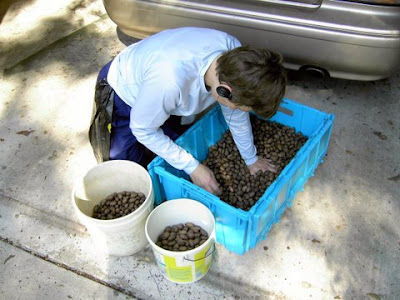

I'm giving you this background in the hopes that as kindred nut-picking spirits you'll be able to share the wild ways of the PA nut traditions.

We also have large businesses that buy nuts from us locals and sell them to Northerners (known here as yankees, with a derisive slur). These businesses pay us about 50 cents a pound, and I suspect we'll have well over a hundred pounds to sell today. Our biggest year was 400 pounds.

We may hit that this year again if John and I can keep our backs in working order. Bending down to pick up pecans is not for babies!

In fact, working with pecans is work!

Saturday, I spent three hours on the roof of our garage harvesting nuts, by the way. If you have a roof, with nut trees overhanging it, you might consider going up there to check out your crop.

So much for nuts.

I need to get back to work.

Love,

Aunt Linda

Tuesday, August 21, 2007

Mike Rychlewski Talks about Dying

My friend Mike, a Chicago writer I’ve known for 40 years, wrote me a letter after reading some of my blogs about my wife Linda’s Uncle Charlie and his dying, and I thought I would pass on what he wrote. Ever since our days together as students at the U of I, Chicago, Mike has always been able to get to the center of things.

Here’s what he sent me about some of the people he loved who died:

Dying from burns over 70% of his body, my father flopped and flailed like someone getting shock treatment or being blasted in the chest with electric mittens. Two nurses were holding him down as he popped up and down.


My mom was lying on her bed in the nursing home with her back to the dark TV screen in the middle of the afternoon when there was a Cub game on. I asked her why she wasn't watching it--she had never missed a game--she said she wasn't interested.

My uncle got up from his bed at the nursing home, walked out the door, hailed a cab and took it ten miles across Denver. The found him that night wandering around the neighborhood he grew up in as a boy.

My other uncle sat on the edge of the hospice bed and took out an imaginary pack of cigarettes from his breast pocket, shook one out, reached into his front pocket for imaginary matches, pealed back the cover, lit the match, held it to the cigarette, took several puffs, finally got it going, and sat there for ten minutes smoking it. It was a performance that would have put Marcel Marceau to shame.

My bachelor cousin at 93 was lying in his gentleman's nursing home hospice room and his nephew from Virginia, who had been bearing witness for two months, finally had to go back to his wife. He said, "I’m leaving now, Mac." Mac said, "Wait!" and he summoned the nurses, insisted they dress him--he was the most elegant dresser I ever knew--he got on his white shirt, blue sport coat, gray slacks, silk tie, lapel handkerchief, spit-shine shoes, took off the oxygen and the IVs, slowly walked to the dining area and ordered the two of them tea and cake. They sat there and ate it. Mac said, "This is what I want your last memory of me to be."

.
There's no meaning, no purpose, no hidden agenda.
.
No one's death is more or less dramatic or poignant.
.
There is no scheme to the universe and we're neither less nor more than nothing.
.
The love of the people we know.
.
Period.
.
If you don't have it, God have mercy on your soul.


[The photo above is of Mike at the graves of his Mother and Father, St. Adalbert's Cemetery, Niles, Illinois, Summer 2005. My parents are buried here also.]

Saturday, August 18, 2007

Hospice, August 17

When we went to the hospice today, Charlie was in another room. The nurses had moved him because he kept trying to get out of bed in his old room. The new room was right next to the nurses’ station, so they could keep track of him better. The could keep an eye on him all the time so he wouldn’t try to get up out of bed and start heading home.

But there didn’t seem much chance of that. Lying in his bed, he seemed quieter, the terminal agitation and restlessness had stopped. Charlie looked at his brother Tony and didn’t move—it was like Charlie was surprised we were there and didn’t have the words or energy to tell us what was going on.

After a minute, he said, "I had a strange experience today." And he tried to tell us about a dream that he had, but he wanted us to know that it wasn’t a dream but that it had really happened, and he wanted us to say that we believed him when he said it really happened. And I said I believed him, and I told Tony who couldn’t hear very well to say that he believed, and he looked at me with a question and then he said he believed.

The story Charlie told was confusing. It must have been some kind of half dream half waking reality that he experienced, and what made it hard for me to understand his story was that I could hear some of what he said but not other parts.

The story was about his home, and somebody trying to take his home away from him, and this person was a communist and a guitar player, and she tried to get the house from him for $99 but he fought her off. He wouldn’t sell no matter what terrible things she did to him, and he kept talking about the way she tried to get him to sell, offering more money and less money and then more money again. And during all of this pressure to sell, Charlie saw above and behind her head these messages that appeared in different colors, yellow and blue and red, and I asked him what the messages meant. He couldn’t tell us because he couldn’t read the messages but he knew that he wouldn’t sell the house for $99 or $77 no matter what she said or what terrible things she did.

And then he stopped talking and asked if I understood. I said I did. I had read in one of those hospice pamphlets that they have lying around here that you should agree with whatever the dying say, so I said I did. And the pamphlet must be right because he seemed happy that I understood. And really, I think I did understand.

Charlie then said, "Give me a hand," and I thought, Oh oh, he’s going to try to get out of bed and that’s just what he started doing -- his feet started moving to the edge of the bed and he gripped the bed rail and started pulling himself up. And I thought, the terminal agitation’s back.

Tony called the nurse, and she came in, and I thought she would try to put Charlie push back into the bed but she didn’t. She helped him out of the bed; she helped him get his feet in his red socks on the floor – and when she had him standing, she held his arms while he took a step and then another toward the bathroom. It was a miracle.

I had to get out of the room – it was too much, and I went into the lobby and sat down. Five minutes later, Tony wheeled his brother out of the room in a wheel chair. They took a spin around the room and went into the dining area and Charlie sat looking out the window toward Pembroke Ave and the north side of Fort Lauderdale.

The gigantic white and blue clouds lifted off the horizon and rose to the rich blue at the top of the sky. It was the kind of day that probably set kids dreaming about visiting Tahiti or Fuji or the islands Herman Melville visited as a boy when the 19th century was still a kid and people traveled across oceans on sailing ships that were like clouds anchored to clean-planed oak planks.

After a while he said he was tired, and Tony wheeled him back into his room, and he and I helped Charlie get out of the chair and into the bed.

As soon as he laid his head down on the white pillow he fell asleep.

Thursday, August 16, 2007

Terminal Agitation, The Hospice, August 14

When Linda told me that the nurse said Uncle Charlie was terminally agitated, I thought she was joking. It reminded me of old washing machines with their agitators and the talk of communist agitators during the 60s and what the old Italians call giving someone "agita." Agitation seemed like such a funny and soft word to describe anything to do with death and the hard facts of dying.

But the nurse said she wasn’t joking and after Linda got off the phone with her, we googled "terminal agitation" and there it was, on a page dealing with hospices.

Here’s what we read:

What is Terminal Restlessness or Agitation?

Those who work with the dying know this type of restlessness or agitation almost immediately. However, the public and patient's family may have no idea what is going on and often become quite alarmed at their loved one's condition. What does it look like? Although it varies somewhat in each patient, there are common themes that are seen over and over again.

Patients may be too weak to walk or stand, but they insist on getting up from the bed to the chair, or from the chair back to the bed. Whatever position they are in, they complain they are not comfortable and demand to change positions, even if pain is well managed. They may yell out using uncharacteristic language, sometimes angrily accusing others around them. They appear extremely agitated and may not be objective about their own condition. They may be hallucinating, having psychotic episodes and be totally "out of control." At these times, the patient's safety is seriously threatened.

Some patients may demand to go to the hospital emergency room, even though there is nothing that can be done for them there. Some patients may insist that the police be called ... that someone unseen is trying to harm them. Some patients may not recognize those around them, confusing them with other people. They may act as if they were living in the past, confronting an old enemy.


I got that from the Hospice Patients Alliance. Here’s there link:

http://www.hospicepatients.org/terminal-agitation.html

But that didn’t come near describing what Charlie was going through.

He wanted so bad to get out of bed and stand up and walk out of the hospital that no word from Tony or the Nurses or the doctor could turn him aside. Charlie wanted to be on his feet and moving toward the door, and more than that. He wanted to walk out the door to the elevator and take the elevator downstairs and then walk into the parking lot and get into his candy-apple red 98 Mercury Sable and drive away from this hospice like a man being chased by the devil.

But he wasn’t going anywhere, even though he moved his feet toward the foot of the bed and he tried to grab the bed rails with his hands and pull himself up. He tried that over and over. You’d put his feet under the sheets, and he would try to lift his shoulders up off the bed. You’d tell him that he couldn’t lift himself up, and he’d try moving his feet toward the edge of the bed. And all the while he’d be talking about leaving the bed and getting stronger and walking out of the hospital. He’s spent days trying to get out of bed and telling us he was feeling fine and was ready to go home—even though he was down to 80 pounds and his skin and eyes were a sandy yellow color.

And when he wasn’t talking about how good he felt, he talked about people he had to call and things he needed to do, the projects he was working on and the places he needed to shop at. His mind was working overtime at time-a-half spinning through all of the unfinished business of his life. He was like a man on fire.